Topic 6.2 Notes – Torque and Work
Work Done by a Torque
You already know linear work is force acting through a displacement. Rotation works the same way.
- Linear work:
- Rotational work:
A torque transfers energy to a rigid system only if the system undergoes an angular displacement.
Two conditions must both be true:
- There is a nonzero torque
- The object rotates through a nonzero angle
If either one is zero, the work is zero.
Sign of the Work
Think about whether the torque helps or resists the rotation.
- Torque and angular displacement in the same direction → positive work (adds energy)
- Torque opposite the direction of rotation → negative work (removes energy)
Example you might see on a quiz:
- A motor applies torque that speeds up a disk → positive work.
- A frictional torque slows it down → negative work.
The sign comes from the product . If they have opposite signs, the work is negative.
The Work-Torque Equation
General Case
If torque depends on angular position:
Key details:
- must be in radians
- Torque is measured in N·m
- Work comes out in joules
Radians are technically dimensionless, but you must use radians for the integral to make physical sense. Degrees will wreck the units.
This is directly parallel to variable force problems from earlier units.
Constant Torque
If torque does not change:
Where .
Quick example:
A constant torque of 8 N·m rotates a wheel 5 rad.
That’s it. Clean and simple.
Be careful. This formula only works if torque truly stays constant over the interval.
Multiple Torques
If several torques act at once:
- Each torque can do its own work.
- The total work equals the work done by the net torque:
Individual torques may add or remove energy. What matters for the system’s energy change is the net work.
On FRQs, they sometimes hide this inside a free-body diagram. You calculate net torque first, then connect it to energy.
Torque vs Angular Position Graphs
When torque is graphed as a function of angular position, the interpretation is exactly like force vs position graphs. The area under a vs graph gives the work done by the torque.
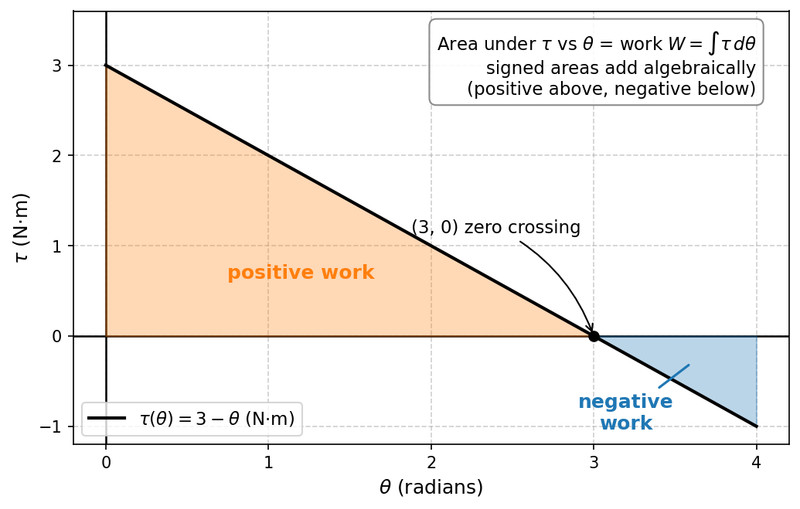
Area under the curve = work done.
- Area above axis → positive work
- Area below axis → negative work
If the graph crosses the axis, treat the positive and negative regions separately and add them algebraically. In a graph like the one above, the work from the positive triangular region and the work from the negative triangular region must be combined with signs.
How to Handle These on a Test
- Identify the interval to .
- Break the region into geometric shapes (rectangles, triangles).
- Compute signed areas.
- Add them carefully.
Common mistake: students find total area without signs. The AP absolutely expects signed area.
How Torque Changes Rotational Energy
Work done by torque changes rotational kinetic energy.
where
So if net work is positive:
- Angular speed increases.
If net work is negative:
- Angular speed decreases.
If net work is zero:
- Rotational kinetic energy stays constant, even if individual torques act.
This is the full rotational analog of .
When you see a problem asking how fast something is rotating after a torque acts through an angle, this is the connection they want you to make.
