Topic 7.2 Notes – Frequency and Period of SHM
1. Period, Frequency, and Angular Frequency in SHM
In SHM, the acceleration has the form which tells you the motion is sinusoidal and repeats in time.
Three timing quantities describe that repetition:
- Period
Time for one complete cycle. Units: seconds. - Frequency
Number of cycles per second. Units: hertz (Hz = s). - Angular frequency
How fast the system moves through its cycle in radians per second. Units: rad/s. Shows up in equations like .
They’re all connected:
A full cycle is radians. That’s why the appears.
What this means physically
- Bigger → more cycles per second → smaller
- Bigger → steeper curvature in the cosine graph → faster oscillation
- If you know one of , , or , you know all three
Quick example: if , then and .
Be comfortable moving between these quickly. That shows up constantly in multiple-choice and as a first step in FRQs.
2. Period of a Mass-Spring Oscillator
For a block of mass attached to an ideal spring with spring constant :
This comes straight from Newton’s 2nd law:
Compare with . So .
What affects the period
- Mass
Larger → larger .
More inertia → harder to accelerate → slower oscillation. - Spring constant
Larger → smaller .
Stronger restoring force → quicker return → faster oscillation.
What does NOT affect the period
- Amplitude
- Maximum speed
- Total mechanical energy
Amplitude is the one that surprises people. If you double the amplitude, the block travels farther, but it also moves faster. The timing balances out.
On tests, they love asking what happens to if the amplitude doubles. For an ideal spring in SHM, the answer is no change.
3. Period of a Simple Pendulum (Small Angles)
For a pendulum of length in a gravitational field , displaced by a small angle:
What affects the period
- Length
Longer pendulum → larger .
The bob takes longer to swing back and forth. - Gravitational field
Larger → smaller .
Stronger restoring torque → faster oscillation.
What does NOT affect the period (for small angles)
- Mass of the bob
- Amplitude, as long as the angle is small
Here’s the setup and force picture you should have in mind:
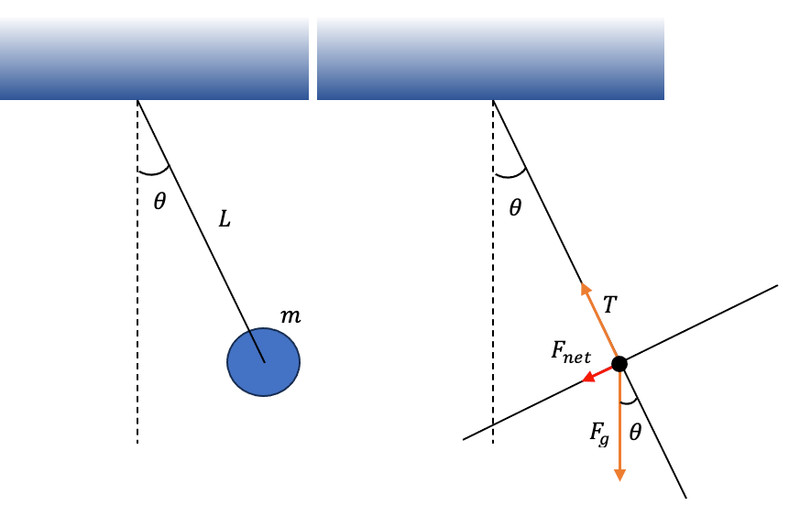
Simple pendulum and its free-body diagram
The left panel shows the geometry with length and angle. The right panel shows the forces on the bob and the component of gravity that acts as the restoring force along the arc.
The motion behaves like SHM only because of the approximation (with in radians).
That approximation is valid only for small angles, roughly under about 10-15 degrees. For larger angles:
- Motion is still periodic.
- But the period becomes slightly longer and depends on amplitude.
On AP problems, assume the formula works unless they clearly say the angle is large.
4. Comparing Spring-Mass and Pendulum Systems
| Feature | Mass-Spring | Simple Pendulum |
|---|---|---|
| Period | ||
| Depends on | , | , |
| Independent of | Amplitude | Mass and amplitude (small θ) |
| Angular frequency |
There’s a pattern hiding here:
- Inertia term resists acceleration (mass or length).
- Restoring term pulls it back (spring stiffness or gravity).
Stronger restoring effect means faster oscillations. Greater inertia means slower ones.
If you ever forget a formula, remembering that structure can help you rebuild it logically instead of guessing.
