Topic 5.2 Notes – Connecting Linear and Rotational Motion
1. How Angular and Linear Quantities Are Connected
Picture a point on the edge of a spinning wheel. It moves in a circle, so you can describe its motion in two ways:
- Angular: how much it turns (θ), how fast it turns (ω), how its turning rate changes (α).
- Linear: how far it travels along the circle (s), how fast it moves (v), how it accelerates (a).
The bridge between them is the radius . And all angles must be in radians.
Angular displacement and arc length
When a body rotates through an angle , a point at distance travels an arc length:
If , then
which is exactly the circumference.
Key idea:
- Every point on a rigid body rotates through the same angle.
- Points farther from the axis travel a greater linear distance.
If a disk turns radians and a point is 0.40 m from the center:
Radians make the equation work cleanly. Degrees will break it.
Angular velocity and linear speed
Different points share the same angular velocity , but their linear speeds depend on :
The velocity is tangent to the circle, perpendicular to the radius at that point.
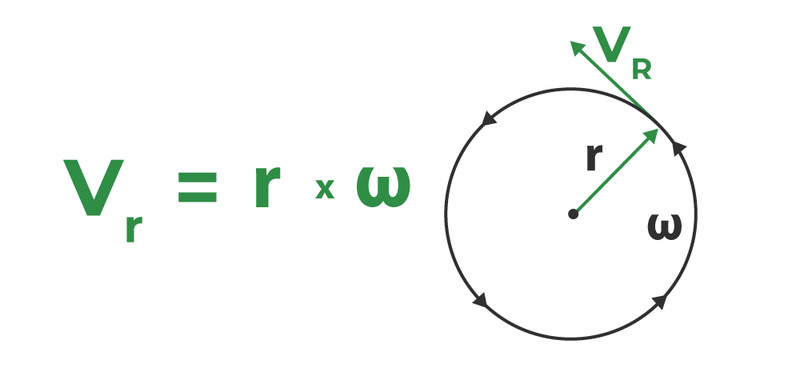
Relationship between angular velocity and tangential speed
If and :
Same ω for every point. Bigger means bigger .
On quizzes, they love asking about two points at different radii. The angular velocity is the same. The linear speeds are not.
Angular acceleration and tangential acceleration
When ω changes, the point has a tangential acceleration:
- changes the speed.
- If , then .
Example:
If and :
Again, larger means larger tangential acceleration.
2. The Full Set of Linear Quantities for a Rotating Point
A rotating point can have three important linear quantities: arc length , velocity , and acceleration. Acceleration is the subtle one.
There are two components:
| Component | Expression | What it does | Direction |
|---|---|---|---|
| Tangential | Changes speed | Tangent to circle | |
| Centripetal | Changes direction | Toward center |
Even if ω is constant, there is still centripetal acceleration because direction keeps changing.
The total acceleration is the vector sum of these two components. At any instant, one vector points inward toward the center and the other lies along the tangent.
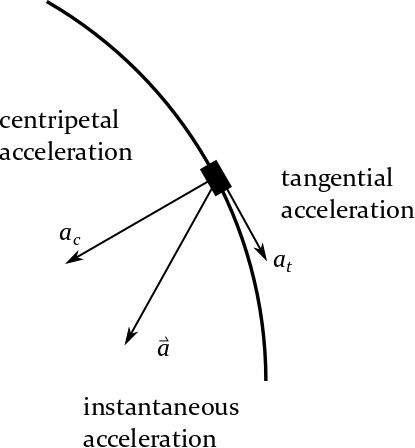
Tangential, centripetal, and total acceleration for circular motion
Uniform circular motion means , so only centripetal acceleration exists.
3. What Makes a Rigid Body Special
A rigid body keeps all internal distances fixed.
For rotation about a fixed axis:
- All points have the same
- All points have the same
- All points have the same
But:
- depends on
- depends on
- depends on
This is why the edge of a fan blade moves faster than a point near the hub.
On the AP exam, you may treat angular quantities with sign (clockwise vs counterclockwise), but you won’t be asked to handle full 3D vector cross products for these kinematics relationships.
4. Setting Up Linear-Rotational Conversion Problems
When you see a rotating object:
- Identify the radius of the specific point.
- Determine which angular quantity is given.
- Use the matching relationship:
- If acceleration is involved, check whether you also need .
Common mistakes:
- Using degrees instead of radians.
- Forgetting centripetal acceleration when ω is constant.
- Assuming linear speeds are the same across the object.
5. Big Picture Connections
These relationships let you translate rotational kinematics directly into linear motion for any point on the body.
The pattern is always:
Once you know the angular behavior of a rigid body, you instantly know the linear behavior of any point, as long as you know its distance from the axis.
