Topic 3.5 Notes – Power
1. What Power Is
Power measures the rate at which energy changes with time.
It describes how fast energy is:
- Transferred into a system
- Transferred out of a system
- Converted from one form to another within a system
The SI unit is the watt (W):
So if something transfers 500 J of energy in 5 s, its average power is 100 W.
Keep the distinction clear in your head:
- Energy tells you how much.
- Power tells you how fast.
Two motors might both lift a 20 kg mass to the same height (same energy change). The one that does it in half the time has twice the power.
2. Average Power
Average power looks at an entire time interval.
Energy Form
could be:
- Thermal energy gained
- Any other energy change in the system
Example:
If a 2 kg block speeds up from 3 m/s to 7 m/s in 4 s:
You’re just dividing total energy change by time.
Work Form
Since work is energy transfer due to a force, we can also write:
This is especially useful when:
- A constant force acts over some displacement
- You compute work first using
- Then divide by time
On quizzes, a common setup is: find the work done by a force, then turn it into power by dividing by the time interval.
3. Instantaneous Power
Average power smooths everything out over time. Instantaneous power tells you the rate at a specific moment.
Calculus Definition
It’s the time derivative of work. Think of it as the limit of as .
Power from Force and Velocity
This is the most important usable form:
where:
- is the angle between force and velocity
- Only the component of force parallel to velocity transfers energy
The diagram below shows a force applied at an angle to the velocity, and then the special case where the force is perpendicular.
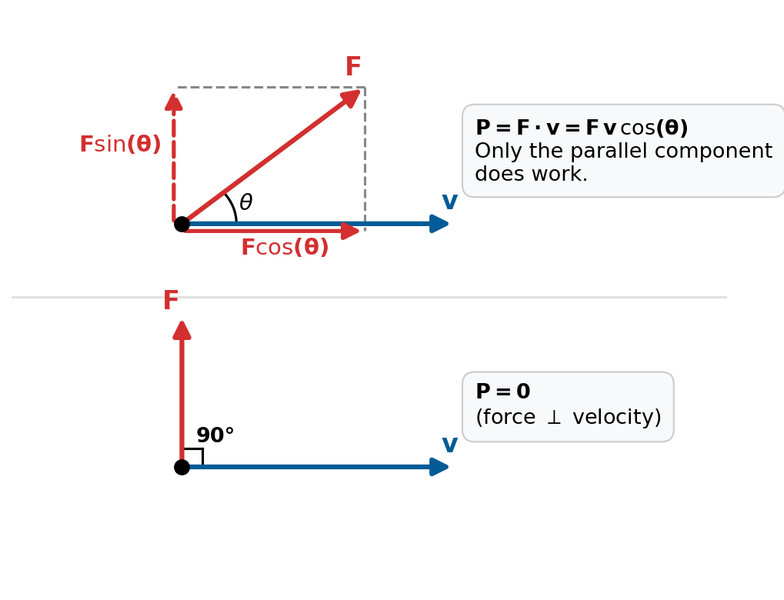
Key cases:
- → (maximum power)
- →
- →
That 90° case is huge. In uniform circular motion, the centripetal force is perpendicular to velocity, so it does no work and delivers zero power, even though the force is nonzero.
4. Interpreting Power in Mechanics Problems
Sign of Power
- Positive power → energy added to the object
- Negative power → energy removed
- Zero power → no energy transfer at that instant
If friction acts opposite motion, . The object’s mechanical energy is decreasing.
Power and Speed
From :
- If a constant force pulls straight ahead, power increases as speed increases.
- At the instant , instantaneous power is zero, even if the force is large.
That last point shows up in conceptual multiple-choice questions. A rocket just starting from rest has zero instantaneous power at that exact instant because .
What AP Free-Response Often Expects
When power appears in FRQs:
- You may be asked to express power as a function of time using .
- If given and , multiply them.
- If you find , remember that total work is . Power and work are directly connected through integration.
Always check units. If your final answer isn’t in watts, something went wrong.
