Topic 7.4 Notes – Energy of Simple Harmonic Oscillators
1. Mechanical Energy in Simple Harmonic Motion
For any system undergoing SHM, the total mechanical energy is the sum of kinetic energy and potential energy:
For a mass-spring system:
Kinetic energy
Depends on the instantaneous speed.Elastic potential energy
Measured from equilibrium .
So at any moment,
As the mass moves, and change, so and change. But their sum does not (assuming no friction).
The graph below shows how , , and total energy vary with displacement :
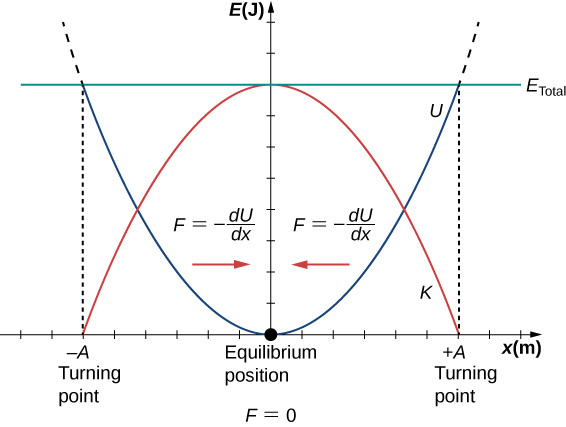
Energy vs. displacement for a mass-spring oscillator
Notice:
- is largest at large , at the turning points .
- is largest at , the equilibrium position.
- The horizontal line shows total energy staying constant.
2. Conservation of Energy in SHM
In ideal SHM, mechanical energy is conserved:
This gives you a powerful alternative to solving and directly. Instead of using trig functions, you can write:
Why is the left side ? Because at amplitude , the mass is momentarily at rest, so all energy is potential.
This equation shows up constantly on tests. If you know amplitude, you know the total energy immediately.
Example setup (don’t plug numbers yet):
If you’re asked for speed at position , rearrange:
That square root structure is worth recognizing.
3. Energy at Key Positions in the Cycle
There are two positions you should instantly recognize.
a. At Equilibrium
- Speed is maximum
- All energy is kinetic
Since ,
Students often think equilibrium means “nothing is happening,” but it’s where the object moves fastest. The net force is zero there, yet the speed is at its peak.
b. At Maximum Displacement
- All energy is potential
Two facts the AP loves conceptually:
- The minimum kinetic energy is zero.
- The maximum potential energy equals total energy.
c. Somewhere in Between
At a general position :
As increases:
- increases
- decreases
When :
That result is commonly tested in multiple-choice.
4. Total Energy and Amplitude
For a spring-mass system, the total energy depends only on amplitude:
This has several important consequences:
- Energy ∝
- Double amplitude → energy becomes 4 times larger.
- Larger → more energy stored (for same ).
- Energy does not depend on where the mass is during motion.
- Changing amplitude changes total energy.
Students sometimes think larger energy means larger frequency. It does not.
The period does not depend on amplitude.
That separation is subtle and often tested in conceptual questions.
5. Solving Energy Problems in SHM
A clean process:
- Identify amplitude .
- Write total energy:
- Write energy at the position of interest:
- Solve for what you need.
Typical quiz questions:
- Speed at a given displacement.
- Displacement where .
- How total energy changes if amplitude changes.
If you see “released from rest at ,” that immediately tells you the total energy.
