Topic 1.5 Notes – Motion in Two or Three Dimensions
1. Motion in Two Dimensions as Independent Components
When something moves in 2D, you are still just doing 1D kinematics. You just do it twice, once for each perpendicular direction.
We describe vectors using components:
The magnitude of a 2D vector comes from the Pythagorean theorem:
Each component follows the familiar 1D equations (for constant acceleration):
The most important idea here is independence:
- Motion in x does not affect motion in y.
- Acceleration can be different in each direction.
- Time is the only thing that connects the dimensions.
If you ever feel stuck in 2D, ask yourself: “What is happening in x? What is happening in y?” Treat them separately.
Three-dimensional motion works the same way. You just add a z-component. In Mechanics, you only calculate 2D quantitatively. Three dimensions may appear conceptually, especially later in E&M.
2. How to Set Up a 2D Kinematics Problem
Most mistakes happen in setup, not algebra.
Choose axes and define positive directions.
Usually +x is horizontal and +y is upward. Write this down mentally so signs stay consistent.Break vectors into components.
If you’re given speed and angle:Check the quadrant so your signs make sense.
Write separate equations for each axis.
- x-equations contain only x-variables.
- y-equations contain only y-variables.
Use time to connect them.
Solve one dimension for , then substitute into the other.Recombine at the end if needed.
- Speed:
- Direction:
A common quiz trap is mixing x and y in the same equation. Keep them cleanly separated.
3. Velocity and Acceleration in Different Dimensions
Velocity and acceleration do not have to “match” across directions.
Different accelerations
You might have:
- ,
- ,
- Both nonzero
- Both varying with time
Changing motion in one direction does not cause a change in a perpendicular direction. For example, if an object accelerates downward due to gravity, its horizontal velocity can remain constant.
Direction can change even if speed doesn’t
Acceleration means the velocity vector changes. That could mean:
- Speed changes
- Direction changes
- Or both
In curved motion, speed might stay constant while direction changes. That still means acceleration exists. The AP sometimes tests this conceptually by asking whether acceleration is zero when speed is constant. It isn’t, unless direction is also constant.
4. Projectile Motion
Projectile motion is just a specific 2D case:
- Only gravity acts (ignore air resistance)
Horizontal motion
Vertical motion
Here’s the full picture of those pieces working together in a typical angled launch:
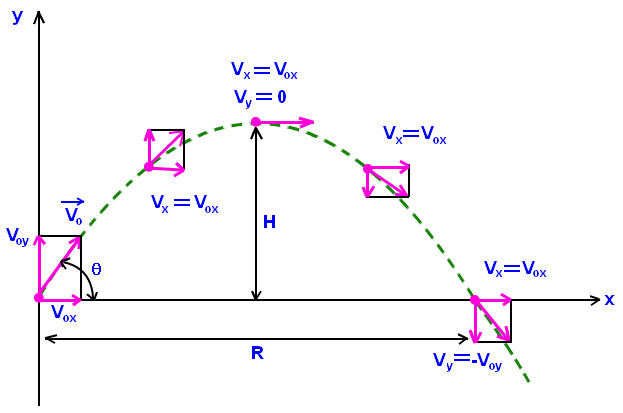
Projectile motion with velocity components, maximum height, and range
The path is a parabola because horizontal velocity stays constant while vertical velocity changes linearly with time.
Same launch and landing height results
If an object lands at the same height it was launched:
Patterns worth knowing:
- Complementary angles give the same range.
- At the top, , but is unchanged.
- For a horizontal launch, time depends only on vertical drop.
Projectile motion is constant horizontal velocity plus constant downward acceleration, connected by time. That’s it.
