Topic 6.5 Notes – Rolling Energy and Momentum of Rotating Systems
1. Total Kinetic Energy of a Rolling Rigid Body
When a rigid body both translates and rotates, its kinetic energy has two pieces:
- → motion of the center of mass
- → rotation about the center of mass
A rolling object always has both terms (unless it’s sliding without spinning or spinning in place).
Why this matters
Two objects can have:
- Same mass
- Same center-of-mass speed
…but different moments of inertia, so different total kinetic energy.
For example:
- Hoop:
- Solid disk:
- Solid sphere:
Bigger means more energy goes into rotation for the same .
On FRQs, students often forget the rotational term when using energy. If it’s rolling, include both.
2. Rolling Without Slipping
Rolling without slipping is a constraint condition. The point touching the ground is instantaneously at rest relative to the surface.
Here’s the geometry and force picture of what’s happening:
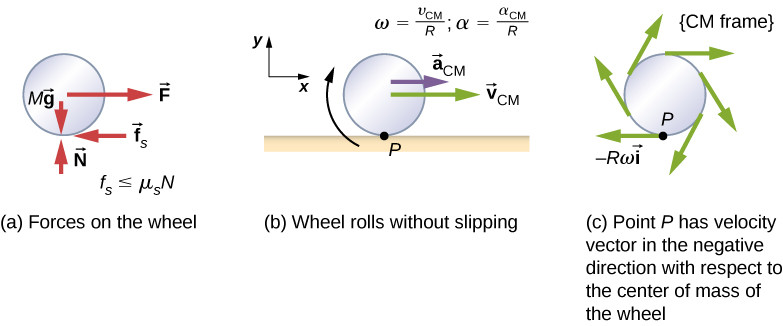
Because of this constraint, linear and angular motion are locked together:
These only apply if there is no slipping.
That substitution is what lets you turn a messy-looking energy equation into something solvable.
Static Friction in Ideal Rolling
In the left panel of the figure, you can see the static friction force at the point of contact. Static friction is what enforces the constraint.
Key facts:
- The contact point does not move relative to the surface.
- Static friction does no work (no displacement at point of contact).
- Mechanical energy can still be conserved.
Students get tripped up because “friction” usually means energy loss. Here it doesn’t.
Also important: rolling friction is not part of AP Physics C scope. If they say “rolls without slipping,” assume ideal static friction.
3. Using Energy and Forces for Rolling Without Slipping
Energy Approach (Most Efficient)
If something rolls down a height :
Substitute :
Factor out and solve.
What controls the final speed is the ratio .
Here’s how common shapes compare:
| Object | Moment of Inertia | Relative Final Speed (same h) |
|---|---|---|
| Hoop | Slowest | |
| Disk / Solid Cylinder | Middle | |
| Solid Sphere | Fastest |
Smaller → less rotational energy → more translational speed.
That ranking shows up constantly in conceptual multiple choice.
Force and Torque Approach
If they want acceleration or friction force, use Newton’s laws:
- Translation:
- Rotation about CM:
- Constraint:
Static friction usually provides the torque that causes angular acceleration.
Be careful with torque signs. Choose a positive rotation direction and stick with it.
4. Rolling With Slipping
Now the constraint breaks.
If the object is slipping:
- Motion must be analyzed separately.
This often happens when:
- A wheel spins on ice
- A ball is thrown with backspin onto a rough floor
Kinetic Friction and Energy Loss
When slipping:
- Friction is kinetic
- The contact point moves relative to the surface
- Friction does negative work
- Mechanical energy decreases
Energy is converted into thermal energy.
In many problems, slipping continues until , and the object transitions into rolling without slipping. During the slipping phase, you cannot use energy conservation.
5. Big Picture Comparison
| Rolling Without Slipping | Rolling With Slipping |
|---|---|
| Static friction | Kinetic friction |
| No direct relation | |
| No energy loss (ideal) | Energy dissipated |
| Energy conservation works | Must include work by friction |
If a problem states “rolls without slipping,” immediately apply the constraint equations. If it says “slipping” or gives a kinetic friction coefficient, translation and rotation must be treated independently.
