Topic 6.1 Notes – Rotational Kinetic Energy
1. Rotational Kinetic Energy
For a rigid body rotating about a fixed axis, the rotational kinetic energy is
- = rotational inertia (kg·m²)
- = angular velocity (rad/s)
This mirrors translational kinetic energy:
The analogy is tight:
- mass ↔ rotational inertia
- linear speed ↔ angular speed
Just like mass measures resistance to linear acceleration, rotational inertia measures resistance to angular acceleration. Bigger or bigger means more rotational kinetic energy.
A quick mental check: if you double , energy increases by a factor of 4. That square shows up constantly in problems.
2. Why This Formula Makes Sense
a. Single Point Mass in Circular Motion
Imagine one particle of mass moving in a circle of radius .
For circular motion, you already know
Its translational kinetic energy is
Substitute :
But is the rotational inertia of a point mass about that axis. So
That means rotational kinetic energy is just ordinary kinetic energy written in angular language.
b. Extended Rigid Body
A real object is just a bunch of tiny masses .
- Each piece has speed .
- Each piece has energy .
- Add them all up.
That sum gives
and leads directly to
So rotational kinetic energy is the total translational kinetic energy of all the little pieces moving in circles.
That idea shows up on FRQs where you’re asked to justify the formula conceptually.
3. Total Kinetic Energy of a Rigid Body
A rigid body can:
- Translate (center of mass moves),
- Rotate about its center of mass,
- Or do both at the same time.
The total kinetic energy is
- First term → translational KE of the center of mass
- Second term → rotational KE about the center of mass
This decomposition is always valid for rigid bodies.
Think about:
- A rolling cylinder
- A wheel on a car
- A thrown football spinning as it moves
Energy problems often hinge on remembering to include both terms.
Common mistake I see on quizzes: using about the wrong axis. If you split energy this way, use .
4. Rotation with Center of Mass at Rest
An object can have rotational kinetic energy even if its center of mass is not moving.
If , then
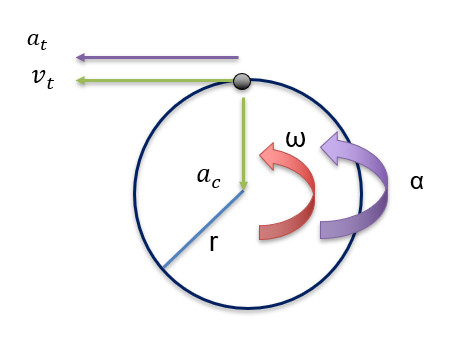
Think of a rigid disk rotating about a fixed axle. The center is at rest, but points on the rim have tangential speed and centripetal acceleration, as shown below.
Examples:
- Flywheel on a fixed axle
- Ceiling fan
- Earth rotating about its axis
Even though the center stays put, every point away from the axis has linear speed , so the object definitely has kinetic energy.
On conceptual multiple-choice, they love asking whether a “stationary” rotating object has kinetic energy. The answer is yes if it’s rotating.
5. Rotational Kinetic Energy Is a Scalar
Rotational kinetic energy:
- Has magnitude only
- Is always positive since
- Does not depend on direction of rotation
Clockwise vs counterclockwise gives the same .
Compare that to:
- Angular velocity → vector
- Angular momentum → vector
- Torque → vector
Energy adds algebraically, which is why conservation of energy problems with rotation are often cleaner than torque-based ones.
