Topic 7.1 Notes – Defining Simple Harmonic Motion (SHM)
1. What Simple Harmonic Motion Is
Start with periodic motion. That just means motion that repeats itself.
- Period : time for one full cycle (seconds)
- Frequency : cycles per second
- A full cycle means same position and same direction of motion.
Plenty of motions are periodic. A planet orbiting the Sun is periodic. A mass bouncing up and down could be periodic. But only some of these are simple harmonic motion.
SHM is periodic motion with one extra requirement:
The net force must be proportional to displacement from equilibrium and point toward equilibrium.
That proportional relationship is what makes the motion “simple” and mathematically clean.
2. The Three Core Pieces of SHM
Everything in SHM revolves around three ideas: equilibrium, displacement, and restoring force.
a. Equilibrium Position
The equilibrium position is where the net force is zero.
If the object is placed there and left alone, it stays there.
Examples:
- Mass-spring (horizontal): where the spring is unstretched.
- Vertical spring: where spring force balances weight.
- Pendulum: the lowest point of the swing.
Displacement is always measured from equilibrium. That’s important. On tests, students sometimes measure from the natural length instead of the equilibrium position in vertical setups.
b. Displacement from Equilibrium
Displacement :
- Can be positive or negative.
- Is measured relative to equilibrium.
- Determines both the size and direction of the restoring force.
In SHM:
- Larger → larger → larger .
- At : force and acceleration are zero.
- At maximum : force and acceleration are maximum.
Here’s the key relationship visually. This is the force-position graph for an ideal spring.
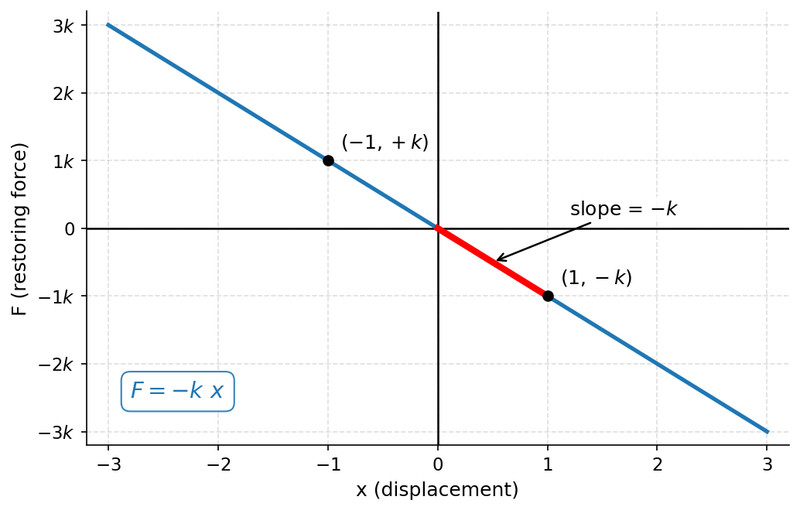
Force vs. displacement for
The straight line passes through the origin and has slope . That negative slope is the restoring behavior. If the force-position graph is linear and goes through the origin with negative slope, you’re looking at SHM.
c. Restoring Force
A restoring force always acts opposite the displacement from equilibrium.
If the object is displaced right, the force points left. If displaced left, the force points right.
For SHM, the restoring force must be linear:
- is a constant (for a spring, the spring constant, units N/m).
- The negative sign encodes “toward equilibrium.”
That equation is exactly what you see represented by the straight line in the graph above.
If the force depends on , or is constant, or doesn’t point toward equilibrium, the motion is not SHM.
That proportionality is the defining feature.
3. How Newton’s Second Law Defines SHM
Now connect this to Newton’s 2nd law.
If the net force is restoring and linear:
Solve for acceleration:
This equation is the definition of SHM in mechanics.
It tells you:
- Acceleration is proportional to displacement.
- Acceleration points opposite displacement.
- The constant controls how quickly the system responds.
On FRQs, you’re often asked to show that a system executes SHM. That means you must:
- Identify equilibrium.
- Write the net force as a function of displacement from equilibrium.
- Show it simplifies to or .
If you can get to that form, you’ve proven SHM.
Why This Leads to Oscillations
Imagine pulling a mass to the right and releasing it. The sequence below shows the block at the rightmost position, at equilibrium, and at the leftmost position, along with the corresponding free-body diagrams.
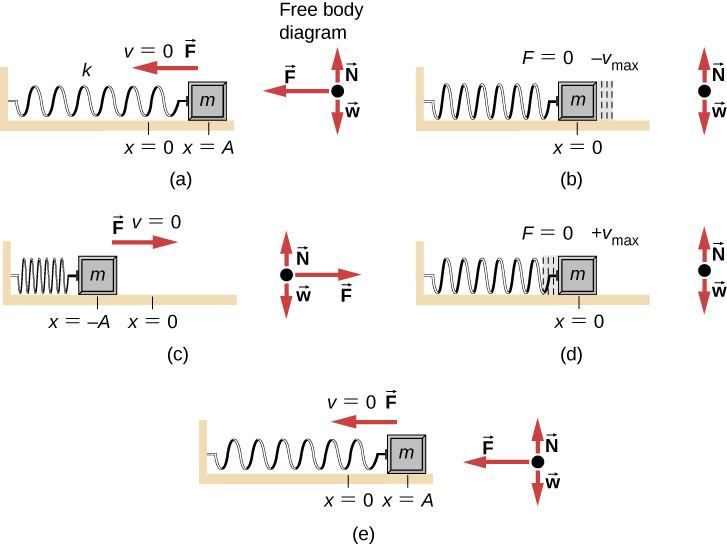
Mass-spring system at different points in one oscillation
- At maximum displacement, velocity is zero and the restoring force is largest.
- As it moves toward equilibrium, the restoring force decreases and the block speeds up.
- At equilibrium, the net force is zero but velocity is maximum.
- It overshoots to the other side.
- Now displacement changes sign.
- The restoring force reverses direction.
- The process repeats.
The constant reversal of direction, caused by the restoring force always pointing toward equilibrium, creates the oscillation.
