Topic 4.4 Notes – Elastic and Inelastic Collisions
1. What Makes a Collision Elastic or Inelastic
A collision means objects interact strongly for a short time. If the system is isolated, the net external impulse is zero, so total momentum is conserved.
What changes from one type to another is the behavior of kinetic energy (KE).
Elastic Collisions
An elastic collision is one where the total kinetic energy of the system is the same before and after:
That does not mean each object keeps the same kinetic energy.
- One object can lose KE while the other gains it.
- The system total stays the same.
- No lasting deformation, heat, or sound energy remains after the interaction.
Atomic and molecular collisions are often modeled as elastic. On AP problems, if they say “elastic,” you immediately know you can conserve both momentum and kinetic energy.
Here’s the big conceptual point students miss:
Even in elastic collisions, individual kinetic energies usually change. It’s the total that stays constant.
Inelastic Collisions
An inelastic collision is one where the total kinetic energy decreases:
Momentum is still conserved if the system is isolated.
Where did the “missing” kinetic energy go?
- Thermal energy (microscopic motion)
- Sound
- Deformation (internal energy)
Total energy is still conserved. It’s just not all kinetic anymore.
On tests, if they don’t say “elastic,” assume kinetic energy is not conserved unless clearly stated.
Perfectly Inelastic Collisions
A perfectly inelastic collision is a special case:
- The objects stick together
- They move with the same final velocity
- The maximum possible kinetic energy is lost (while still conserving momentum)
If two objects stick, you already know it’s perfectly inelastic. That single phrase tells you the entire setup.
For example, imagine sliding toward a stationary on a frictionless surface. After the collision, they stick and move together with a common velocity .
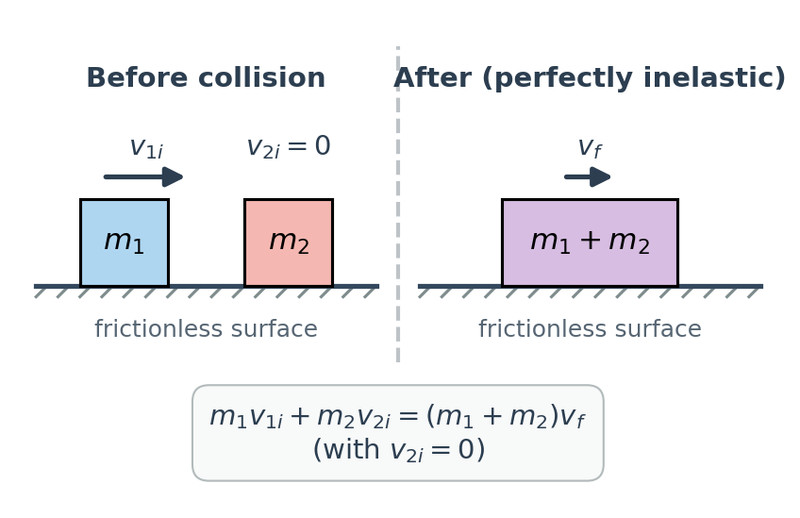
Perfectly inelastic collision on a frictionless surface
2. The Two Governing Principles
Everything in collision problems comes from these two ideas.
Conservation of Momentum
For an isolated system:
- Always true (elastic or inelastic)
- It’s a vector equation
- In 1D, use signs carefully
- In 2D, conserve x and y components separately
Momentum conservation comes from Newton’s Third Law. Internal forces cancel in pairs.
Conservation of Kinetic Energy (Elastic Only)
Only for elastic collisions:
This gives you a second equation to solve for unknown final velocities.
If you use this in an inelastic collision, your answer will be wrong even if your algebra is perfect.
Kinetic Energy Change
For inelastic cases:
You’re often asked to compute this after finding the final velocity from momentum.
3. Solving Collision Problems
The setup depends entirely on the collision type.
Elastic Collision in 1D
You need two equations:
- Momentum conservation
- Kinetic energy conservation
Example setup (no numbers, just structure):
- Write
- Write the KE equation
- Solve simultaneously
Patterns worth remembering:
- Equal masses, one initially at rest → velocities exchange.
- A much lighter object tends to bounce back with large speed change.
These patterns show up in conceptual multiple-choice questions.
Perfectly Inelastic Collision
Objects share a final velocity :
Steps:
- Solve for
- Compute KE before
- Compute KE after
- Subtract to find energy lost
No kinetic energy conservation equation here. Ever.
General Inelastic (Not Sticking)
- Momentum conserved
- KE not conserved
- Final velocities are usually given or partially known
Never assume they move together unless told explicitly.
4. Comparing Elastic and Inelastic Collisions
| Feature | Elastic | Inelastic | Perfectly Inelastic |
|---|---|---|---|
| Momentum conserved | Yes | Yes | Yes |
| Kinetic energy conserved | Yes | No | No |
| Objects stick together | No | No | Yes |
| KE lost | 0 | Some | Maximum possible |
One last conceptual insight:
Momentum conservation comes from symmetry and internal forces. Kinetic energy conservation depends on whether nonconservative processes occur during impact.
On FRQs, graders look for you to clearly state which conservation laws apply before writing equations. That single sentence can earn a point.
