Topic 5.4 Notes – Rotational Inertia
1. What Rotational Inertia Is
When something rotates, Newton’s second law becomes
So plays the same role in rotation that mass plays in .
What determines ?
- Total mass
- Distribution of mass relative to the axis
- Distance from the axis matters a lot because it’s squared
For a single point mass:
- = mass
- = perpendicular distance to the axis
If you double , becomes four times bigger. That square is everything.
For multiple discrete masses:
Each mass contributes based on its own distance from the same axis.
For a continuous object:
You break the object into tiny mass pieces , multiply each by , and integrate.
Two big conceptual anchors:
- The same object can have different values for different axes.
- Moving mass farther from the axis increases dramatically.
Here’s the classic comparison between a thin hoop and a solid disk about their central axes:
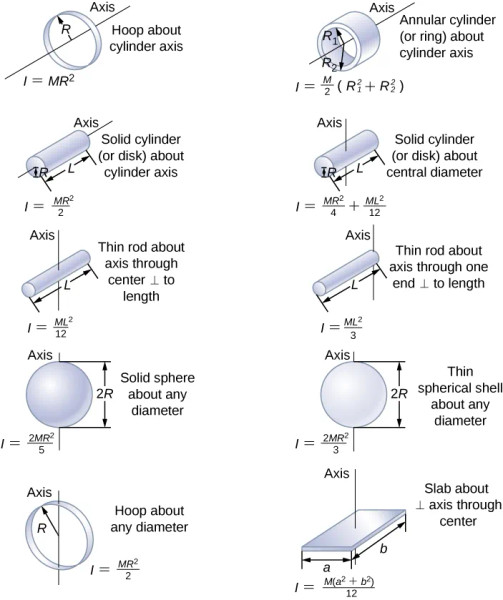
Standard moments of inertia for common shapes
Focus on the top-left two diagrams in the figure.
Same , same .
The hoop has all its mass at distance . The disk has mass spread inward.
So is larger than .
2. Standard Rotational Inertia Results You Should Know
These come from evaluating . You don’t memorize randomly. You connect them to mass distribution.
Thin rod (length , mass , axis ⟂ to rod)
- About center:
- About one end:
About the end is larger because more mass is farther from the axis on average.
Solid disk or solid cylinder (radius )
- About central axis:
Thin hoop or thin cylindrical shell
- About central axis:
You’re expected to be able to derive:
- Thin rods (uniform or nonuniform density)
- Disks or shells built from coaxial rings
- Annular rings about a central axis
Typical setup on an FRQ:
- Choose axis and coordinate.
- Write using density.
- Plug into .
- Integrate over the object.
They love giving a nonuniform density like . Just stay systematic.
3. Rotational Inertia and the Center of Mass
A rigid object’s rotational inertia is minimum when the axis passes through its center of mass.
That’s not random. The center of mass is the “balance point” of the mass distribution. Any parallel axis shifted away moves mass farther out overall, which increases .
That’s why figure skaters spin faster when they pull their arms in. They reduce , so for constant angular momentum, angular speed increases.
4. The Parallel Axis Theorem
This connects an axis through the center of mass to any parallel axis:
- = inertia about new axis
- = inertia about CM axis
- = total mass
- = perpendicular distance between axes
That term is always positive. Shifting the axis always increases .
For example, a slender rod has about an axis through its center. If you shift to a parallel axis through one end, the distance between axes is , which gives
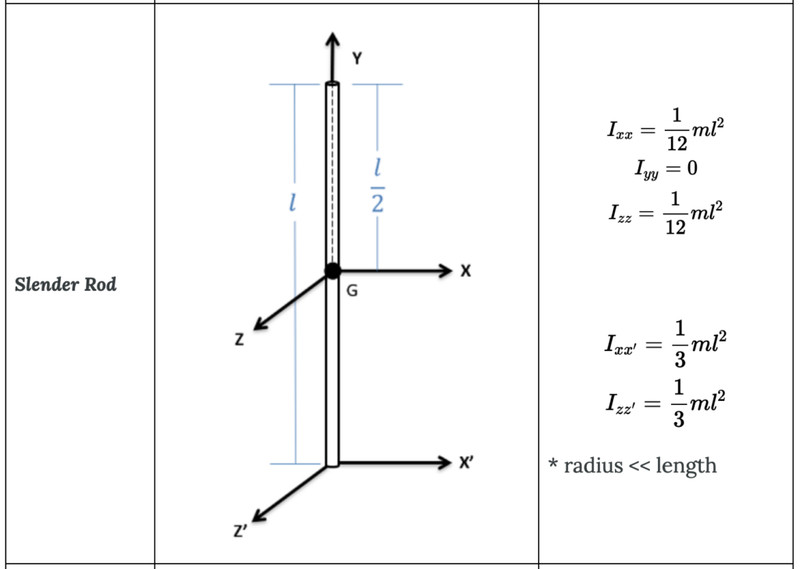
Slender rod: center-of-mass axis vs. end axis
Classic uses:
- Rod about one end (derive from center result)
- Disk about a tangent axis
- Composite objects where you shift each part to the same axis
On tests, the most common mistake is using the wrong . It must be the perpendicular distance between the two parallel axes, not from the edge of the object.
5. How to Think About Rotational Inertia on Problems
When you see a rotation problem:
- Define the axis first.
- Decide if it’s:
- Point masses → use
- Continuous → use integral or known formula
- Shifted axis → use Parallel Axis Theorem
- For composite objects:
- Find for each piece about the same axis
- Add them
If you’re stuck conceptually, ask yourself one question:
Where is most of the mass relative to the axis?
That almost always tells you which object has larger , even before calculating.
