Topic 5.6 Notes – Newton’s Second Law in Rotational Form
1. Newton’s Second Law for Rotation
Angular velocity changes only when there is a nonzero net torque acting on the object.
The rotational version of Newton’s Second Law is
- = net external torque about a chosen axis
- = rotational inertia about that axis
- = angular acceleration
This mirrors linear motion:
So think:
- Force → linear acceleration
- Torque → angular acceleration
- Mass → rotational inertia
What this tells you
- If , then
→ angular velocity is constant (could be zero or spinning steadily). - If , then
→ changes.
Proportional relationships matter a lot on tests:
More torque gives faster change in spin. Larger rotational inertia makes it harder to change the spin.
Direction and sign
In 2D:
- Counterclockwise is usually positive.
- Clockwise is negative.
The direction of is the same as the direction of net torque. If you mess up signs here, everything falls apart, so pick a convention and stick to it.
2. Rotational Inertia
Rotational inertia measures how hard it is to change an object’s rotation. Unlike mass, it depends on how the mass is distributed relative to the axis.
General definitions:
The key idea is the . Mass farther from the axis contributes way more.
What affects
- Total mass
More mass → larger (if shape is similar). - Distance from axis
Doubling the radius increases contribution by a factor of 4. - Choice of axis
Same object, different axis → different . Always check what axis the problem uses.
Comparing common shapes
For objects with the same and :
| Object | Rotational Inertia | Mass distribution |
|---|---|---|
| Solid disk / cylinder | Mass spread throughout | |
| Thin hoop | All mass at radius |
The hoop has larger . So for the same torque:
- Smaller → larger
- Larger → smaller
That’s why a solid cylinder rolls down an incline faster than a hoop. The torque from friction is similar, but the solid cylinder has smaller , so it gets a bigger angular acceleration.
3. Applying
Here’s the structure you should see in your head:
- Choose an axis.
- Draw a free-body diagram.
- Compute each torque:
- Add them with signs.
- Set equal to .
Torque comes from real forces only. There is no such thing as a “centripetal torque.”
When you calculate torque, you’re using the geometry shown below.
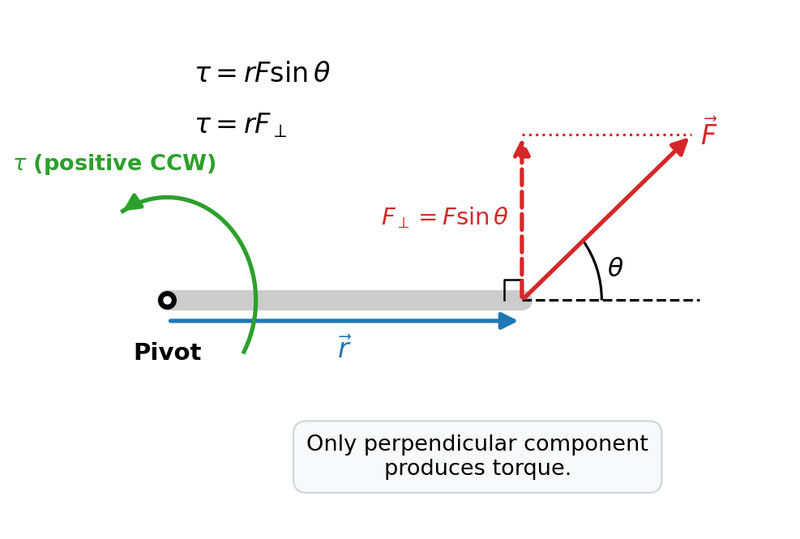
Torque from an angled force about a pivot
The position vector runs from the pivot to the point where the force is applied. The angle is between and , not between the force and the horizontal unless those happen to be the same.
Only the perpendicular component produces torque, which is why .
Also remember: only external torques change the rotation of a system.
4. Linear and Rotational Analyses Together
Many AP problems require both:
They describe different aspects of the same object.
When you need both
Rolling without slipping
- Translation of center of mass
- Rotation about center of mass
- Constraint:
You’ll often write:
- Then use
Pulley systems
- Tension causes linear acceleration of hanging mass.
- That same tension causes torque on the pulley.
You must write one equation for translation and one for rotation, then solve simultaneously. Students often forget one of them and end up missing a variable.
5. When Angular Velocity Changes
Angular velocity changes only if the net torque is not zero.
Three cases to recognize fast:
- → constant
- Constant → constant → use angular kinematics
- Changing torque → changing → must use dynamically
If torque reverses direction, angular acceleration reverses immediately.
This is exactly like linear motion. The structure of the reasoning is identical.
