Topic 2.5 Notes – Newton’s Second Law
Newton’s Second Law
Here’s the core relationship:
This equation is about the center of mass of a system.
- = vector sum of all external forces
- = total mass of the system
- = acceleration of the system’s center of mass
Two things matter immediately:
- Direction: points in the same direction as the net external force.
- Proportionality:
- Double the net force → double the acceleration.
- Double the mass → half the acceleration.
Because this is a vector equation, you must treat forces in components:
On FRQs, missing components is one of the fastest ways to lose points.
If the net force is constant, the acceleration is constant. That means you can immediately connect to kinematics:
Force causes acceleration. Acceleration changes velocity. That chain is everything here.
Net Force and Unbalanced Forces
What “net force” actually means
The net force is the vector sum of all external forces acting on the system.
If
the forces are unbalanced.
Unbalanced can mean:
- One force acting alone
- Multiple forces that don’t cancel
- Forces at angles whose components don’t cancel
Balanced vs Unbalanced
| Balanced Forces | Unbalanced Forces |
|---|---|
| Velocity is constant (could be zero or nonzero) | Velocity changes (speed and/or direction) |
Students often mix this up: zero net force does not mean the object is at rest. It means no change in velocity.
External vs Internal Forces
This matters a lot in multi-object systems.
- External forces come from outside the system.
- Internal forces are forces between objects inside your chosen system.
Internal forces come in Newton’s Third Law pairs and cancel when considering the whole system.
If you define your system as two blocks pushing on each other, the contact forces between them disappear from the equation. Many AP questions quietly test whether you understand that.
When and How Velocity Changes
Velocity changes only if there is a nonzero net external force:
No net force → no acceleration → constant velocity. That’s Newton’s First Law embedded inside the Second.
Remember, velocity is a vector. It changes if:
- Speed changes (parallel net force)
- Direction changes (perpendicular net force)
- Or both
If the net force points in the same direction as the velocity, the object speeds up. If the net force is perpendicular to the velocity, the object’s direction changes (this is centripetal acceleration).
The right-hand case is uniform circular motion. Speed stays constant, but velocity changes because the direction changes. That shows up constantly in AP problems.
How to Apply Newton’s Second Law
When you’re solving a problem, the structure is predictable.
- Define the system. Single object or multiple together?
- Draw a free-body diagram.
For example, here’s a simple free-body diagram for a block on a flat surface.
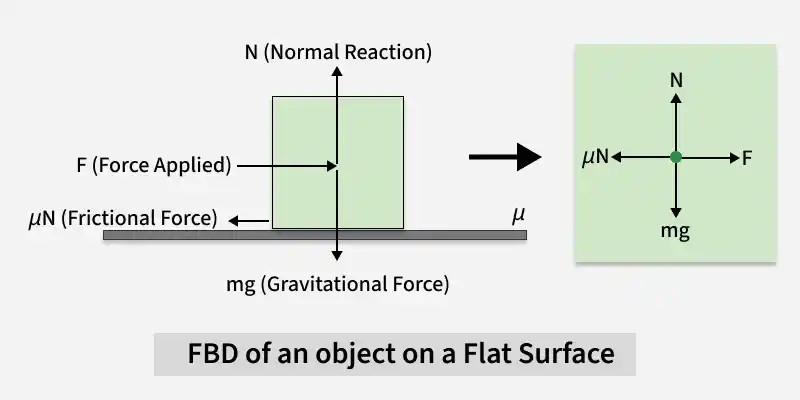
Free-body diagram of a block on a horizontal surface
- Choose axes (often align with motion or incline).
- Write component equations:
- Solve for acceleration, then use kinematics if needed.
Quick example: A 4 kg cart has 18 N right and 6 N left.
Net force = 12 N right.
If that force stays constant for 5 s and it starts from rest:
That full chain from forces → acceleration → velocity change is exactly what FRQs love.
