Topic 2.8 Notes – Spring Forces
1. What the Spring Force Is
An ideal spring exerts a restoring force that depends on how far it’s stretched or compressed from its relaxed length.
Hooke’s Law
- = spring constant (N/m), a measure of stiffness
- = displacement from equilibrium (stretched or compressed)
- The negative sign means the force points toward equilibrium
If you define right as positive and pull the spring to the right, . The force will be negative, meaning it pulls left.
Direction of the Force
The spring always tries to return to its relaxed length.
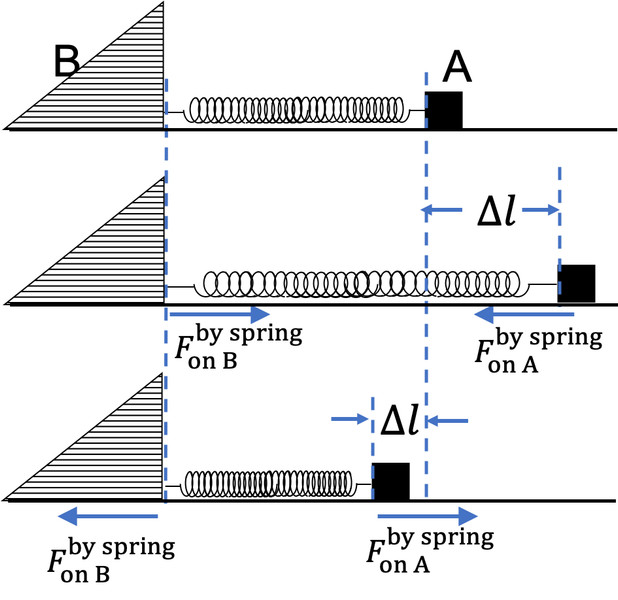
Spring force in compressed, equilibrium, and stretched positions
- Stretched → pulls back.
- Compressed → pushes outward.
- Always along the axis of the spring.
That “toward equilibrium” idea is huge. On FRQs, if you forget which way the force points, you’ll get sign errors that carry through everything.
What the Spring Constant Means
- Larger → stiffer spring → more force for same
- Smaller → softer spring
- Units N/m tell you it’s force per meter of stretch
If a 400 N/m spring and a 100 N/m spring are both stretched 0.10 m, the first one pulls four times harder.
Ideal vs Nonideal Springs
AP Physics C assumes ideal springs unless told otherwise.
- Ideal
- Negligible mass
- Perfectly linear
- Nonideal
- May have noticeable mass
- May become nonlinear at large stretches
- Can permanently deform past elastic limit
You won’t be asked to model nonlinear springs here.
2. Spring Forces and Newton’s Second Law
A spring force is just another force in
Draw it in your free-body diagram like you would gravity or tension.

Mass-spring system at different positions with corresponding free-body diagrams
The panels show the block at different positions in its motion. In each free-body diagram, the vertical forces and cancel, and the horizontal force is the spring force.
A typical setup goes like this:
- Choose a coordinate system (often equilibrium is ).
- Draw the FBD.
- Write .
- Substitute .
Example structure: a mass on a frictionless surface attached to a spring.
That equation shows something important. The acceleration is proportional to position and opposite in direction. That restoring behavior is what leads to oscillations later in the course.
One common mistake on quizzes is inventing extra forces. The spring force itself is the restoring force. There isn’t a separate “restoring force” term.
At equilibrium, net force is zero. If the block is displaced, the spring provides the net force that accelerates it back.
3. Equivalent Spring Constant
Multiple springs can act like a single spring with constant . You are only responsible for systems that are entirely in series or entirely in parallel, not mixed.
a. Springs in Series
Connected end-to-end.
- Same force through each spring
- Total displacement = sum of individual displacements
Key pattern:
- is less than the smallest individual
- Adding springs in series makes the system more flexible
Why? The same force stretches each spring, so total stretch increases.
If N/m and N/m:
So N/m, smaller than both.
b. Springs in Parallel
Attached side-by-side to the same two points.
- Same displacement for each spring
- Total force = sum of individual forces
Key pattern:
- is greater than the largest individual
- Adding springs in parallel makes the system stiffer
If two 300 N/m springs are in parallel, N/m.
Quick Comparison
| Feature | Series | Parallel |
|---|---|---|
| Same for each spring | Force | Displacement |
| What adds | Displacements | Forces |
| Formula | Reciprocals add | Constants add |
| Effect on stiffness | Decreases | Increases |
On multiple-choice questions, they often test your intuition before the math. If your answer for series is bigger than the biggest spring, something is wrong.
