Topic 3.3 Notes – Potential Energy
1. What Potential Energy Is
Potential energy belongs to a system, not a single object. A system has potential energy when its objects interact only through conservative forces like gravity or ideal springs.
- It depends on relative position (separation distance, height, stretch).
- It is a scalar. No direction.
- Only changes in potential energy matter physically.
If only conservative forces act, the system’s mechanical energy stays constant.
Conservative forces refresher
A force is conservative if:
- Work is path-independent.
- Work over any closed loop = 0.
- You can define a potential energy function for it.
Gravity and ideal springs qualify. Kinetic friction does not.
Choosing the zero of
You are free to define where . That choice:
- Shifts all values by a constant.
- Does not change forces or motion.
Common choices:
- Ground level for near-Earth problems.
- Spring equilibrium length.
- for gravitational interactions between planets.
On FRQs, graders don’t care where you set zero as long as you stay consistent.
2. The Link Between Force and Potential Energy
The deep connection is through work.
So if a conservative force does positive work, decreases. If it does negative work, increases.
In one dimension, this becomes incredibly useful:
This means:
- Force points toward decreasing .
- Steeper slope → larger magnitude of force.
- Flat region → zero force → possible equilibrium.
If you’re given on a test, you should immediately think “take the derivative and add a minus sign.”
3. Reading and Using Potential Energy Graphs
Here’s a typical potential energy curve.
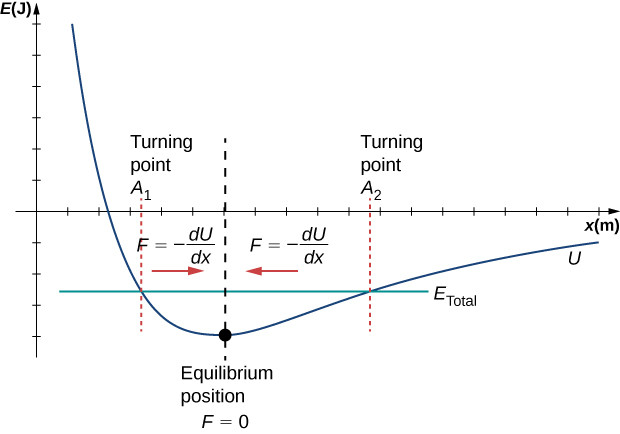
Potential energy with equilibrium and turning points
Slope tells you the force
Use the slope of the curve at any point.
- Positive slope → (force left).
- Negative slope → (force right).
- Zero slope → equilibrium candidate.
Types of equilibrium
At any equilibrium, so . In the graph above, the bottom of the well is a stable equilibrium.
- Stable equilibrium
- Local minimum.
- Small displacement → force pulls it back.
- Mathematically .
- Unstable equilibrium
- Local maximum.
- Small displacement → force pushes it away.
- .
- Neutral equilibrium
- Flat region.
- Small displacement → no restoring force.
On multiple-choice questions, they love asking which point is stable just from the graph. Always think “valley = stable.”
Total energy on the graph
Now add a horizontal line for total energy , like the one labeled in the figure.
- Where , kinetic energy . Motion allowed.
- Where , . These are turning points.
- Where , motion is impossible.
If you see two turning points, that’s oscillatory motion trapped in a “well.”
4. Common Potential Energy Functions
Elastic spring
- is displacement from equilibrium.
- Parabolic curve.
- Minimum at → stable equilibrium.
- Taking derivative gives .
Notice energy depends on , so compression and stretch both store positive energy.
Gravitational potential energy (two-body)
- is center-to-center distance.
- Negative because gravity is attractive.
- Standard reference is at .
If total mechanical energy is negative, the system is bound. That shows up in orbit questions.
Near Earth’s surface
Valid when height is small compared to Earth’s radius so is constant. This is just a linear approximation of the full .
5. Systems with More Than Two Objects
For multiple objects, total potential energy is the sum of all pairwise interactions.
With objects, number of pairs is:
Each pair contributes its own term.
So for three masses interacting gravitationally, you add:
Students often forget one pair on exams and lose easy points.
Lower total potential energy generally means a more stable configuration. Systems tend to move toward lower when possible.
