Topic 2.2 Notes – Forces and Free-Body Diagrams
1. What a Force Is
A force is an interaction between two objects or systems that can cause acceleration. If nothing interacts with an object, no force acts on it.
Key facts:
- A force is a vector → it has magnitude and direction.
- SI unit: newton (N).
- A force on an object is always caused by something else.
- An object cannot exert a net force on itself.
- Forces come in interaction pairs (Newton’s Third Law):
- If A pushes B, B pushes A with equal magnitude and opposite direction.
- These two forces act on different objects. Never put both on the same FBD.
If you’re unsure whether to draw a force, ask: What object is interacting with this one?
Contact vs Non-Contact Forces
Contact forces happen when objects touch. At the atomic level, they’re electric forces between atoms, but you treat them as macroscopic forces.
Common forces you must recognize instantly:
- Gravitational force (weight)
Direction is toward Earth’s center (down near the surface). - Normal force
Perpendicular to a surface. It prevents objects from passing through surfaces.
It is not automatically equal to . - Friction
Parallel to surface. Opposes motion or impending motion. - Tension
Pull through a rope/cable. Always pulls away from the object along the rope. - Applied force
A push or pull by a person or object. - Spring force
Restoring force given by .
When you see a setup, your brain should immediately scan for these.
2. What a Free-Body Diagram Shows
A free-body diagram (FBD) shows all external forces acting on one object.
For example, consider a block on a horizontal surface being pushed to the right. Its FBD includes: normal force up, weight down, applied force to the right, and friction opposing the motion.
Rules that matter for the AP exam:
- Draw the object as a dot (center of mass).
- Each force:
- One straight arrow
- Starts at the dot
- Points in true direction
- Clearly labeled
- If two forces point the same way, draw them side by side, not overlapping.
- Do not draw components on the FBD.
- Include only forces acting on the object, not forces it exerts on others.
The FBD is your bridge to
If the diagram is wrong, everything after it collapses.
3. How to Construct a Free-Body Diagram
When you’re stuck, walk through this logic:
- Choose the object. Everything else becomes the environment.
- Draw a dot for its center of mass.
- Ask: What is interacting with this object?
- Earth → gravity
- Surface → normal, maybe friction
- Rope → tension
- Draw one arrow per interaction.
- Label clearly.
- Sanity check:
- Did you include weight?
- Did you invent a “centripetal force”? (That’s not a separate force.)
- Did you accidentally include a Third Law partner?
Common mistakes that cost points:
- Forgetting normal force.
- Automatically setting .
- Drawing force components.
- Putting motion direction arrows on the FBD.
4. Choosing a Coordinate System
After the FBD, you choose axes to make Newton’s Second Law easier.
Best practice:
- Align one axis with the direction of acceleration.
- Align axes with surfaces when possible.
Inclined Plane Example
On an incline, rotate your axes so they line up with the surface rather than staying horizontal and vertical.
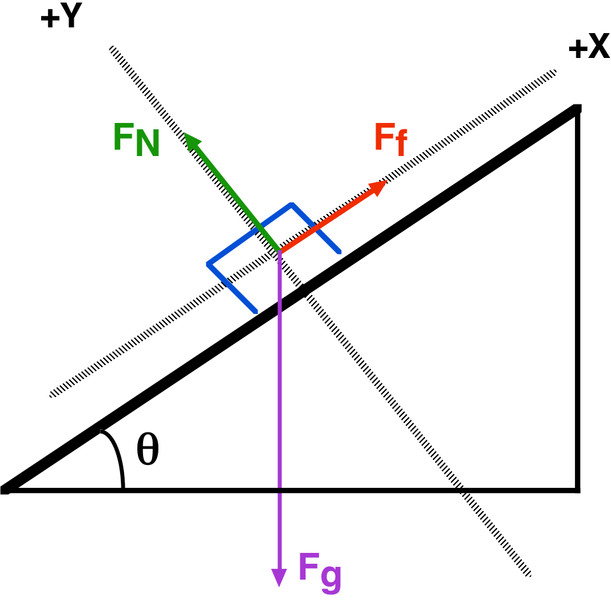
Block on an inclined plane with axes parallel and perpendicular to the slope
For an incline:
- x-axis parallel to slope
- y-axis perpendicular to slope
- Acceleration is usually along the slope only
Now the normal force points purely in the y-direction, and any acceleration is typically along x. That keeps one acceleration component zero, which simplifies
A bad axis choice means extra trig and messy algebra.
5. From FBD to Newton’s Second Law
Now you translate picture to math:
- Choose axes.
- Write
- Substitute expressions (like , , etc.).
- Solve.
Core ideas:
- Net force causes acceleration, not motion.
- If acceleration is zero, then net force is zero.
- In circular motion, inward forces add to . Do not draw “centripetal force” as its own arrow.
On FRQs, graders look at your FBD before they even check algebra. A clean, correct diagram often earns points even if the math later slips.
