Topic 3.2 Notes – Work
1. What Work Is
Work measures energy transferred by a force acting over a displacement.
The full definition is
That dot product matters. It tells you only the part of the force parallel to the displacement of the point of application changes the system’s energy.
Dot Product and Direction
For a constant force:
- is the angle between force and displacement.
- Work is a scalar.
- It can be:
- Positive → force component in direction of motion (adds energy)
- Negative → force opposes motion (removes energy)
- Zero → force perpendicular to motion
If a centripetal force keeps an object moving in a circle, it does zero work because it’s perpendicular to velocity. It changes direction, not speed.
If multiple forces act:
You add them algebraically since work has no direction.
2. Calculating Work
Constant Force
For constant magnitude and direction:
Example idea: You pull a crate 4 m with a 20 N force at above horizontal.
Only the horizontal component does work:
The vertical component doesn’t change kinetic energy because there’s no vertical displacement.
Be careful: it’s the displacement of the point where the force acts, not automatically the center of mass in every situation.
Variable Force
If force changes with position:
In 1D:
Graphically, work is the area under the curve of vs. x. For a linearly increasing force like the one below, the work is the area of the triangle under the line.
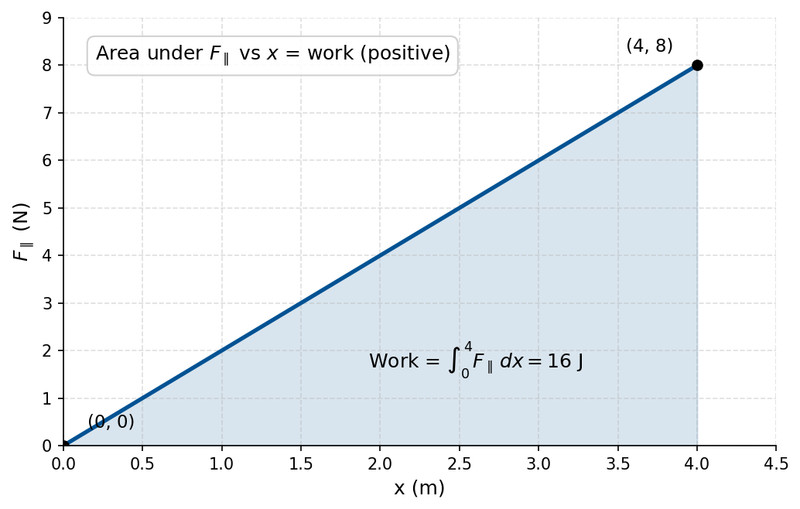
Work as area under an vs. graph
Area above the axis → positive work.
Area below → negative work.
Classic example: Spring
Hooke’s law:
Work from to :
The integral just adds up tiny pieces.
3. Conservative vs Nonconservative Forces
This distinction explains when mechanical energy is conserved.
Conservative Forces
Examples:
- Gravity
- Ideal spring force
They have three key properties:
- Path independent
Work depends only on initial and final positions. - Zero work over a closed path
If the system returns to its original configuration, total work is zero. - Have potential energy
Conservative forces shuffle energy between and . Mechanical energy stays within the system.
Nonconservative Forces
Examples:
- Friction
- Air resistance
They are:
- Path dependent
- Associated with mechanical energy leaving the system (usually thermal)
Often modeled as:
Mechanical energy changes according to:
AP scope note: you track the mechanical energy change, even though physically it becomes thermal or sound energy.
Here’s the contrast clearly:
| Conservative | Nonconservative | |
|---|---|---|
| Path dependence | No | Yes |
| Closed loop work | Zero | Nonzero |
| Potential energy? | Yes | No |
| Mechanical energy | Redistributed | Changed (dissipated) |
4. Work-Energy Theorem
The core result:
This comes straight from Newton’s second law.
It applies to all forces. Conservative and nonconservative both contribute to .
Interpreting It
- If net work is positive → speed increases.
- If net work is negative → speed decreases.
- If net work is zero → speed unchanged.
On exams, this often replaces kinematics. If you only care about speeds, energy is usually cleaner.
Object vs System Modeling
If the center of mass and the point of application move the same distance, model it as a single object and track only kinetic energy.
If a force changes internal configuration, like compressing a spring, then external work can change:
- Kinetic energy
- Potential energy
That modeling decision is where students lose points on FRQs. Be explicit about your system.
