Topic 7.5 Notes – Simple and Physical Pendulums
1. What a Physical Pendulum Is
A physical pendulum is any rigid body that swings about a fixed pivot under gravity.
Key features:
- The object is a rigid body (rod, disk, irregular shape).
- It rotates about a fixed axis.
- Its center of mass (CM) is a distance from the pivot.
- Its rotational inertia is , taken about the pivot.
Here’s the geometry you should picture as you read the torque expression below:
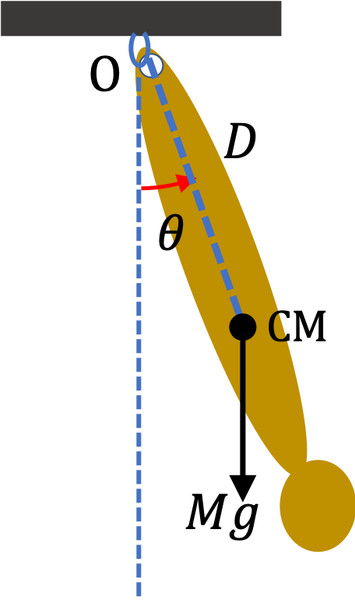
Physical pendulum displaced by angle
When displaced by an angle , gravity acts at the CM and produces a torque about the pivot.
Restoring Torque from Gravity
The torque due to gravity is
Why this form?
- Lever arm is .
- Component perpendicular to the rod gives .
- The negative sign means the torque restores the pendulum toward equilibrium.
This plays the same role as in linear SHM.
2. Small-Angle Approximation and Why It Leads to SHM
For small angles (in radians, usually less than about 0.2 rad):
Then the torque becomes
Now apply rotational Newton’s second law:
So,
Since ,
That is the exact form of SHM:
So,
and the period is
What controls the period?
- Larger → more rotational inertia → longer period
- Larger → stronger restoring torque → shorter period
- Mass only matters through how it affects
On FRQs, they often want you to derive this from torque and show the SHM differential equation. Make sure you explicitly write and substitute the small-angle approximation.
3. Types of Pendulums
a. Physical Pendulum (General Case)
This is the full formula:
Steps you usually need:
- Find (distance from pivot to CM).
- Find about the pivot.
- If given , use the parallel-axis theorem:
For example, a uniform rod pivoted at one end:
- Use parallel-axis to get
Students often forget that must be about the pivot, not the CM. That mistake costs easy points.
b. Simple Pendulum
A simple pendulum is a special case of a physical pendulum:
- Point mass
- Massless string
- Length
Here:
Plug into the physical pendulum formula:
Important properties:
- Independent of mass.
- Depends only on and .
- Valid only for small angles.
If the problem says “small oscillations” and gives a point mass on a string, this is your go-to result.
c. Torsion Pendulum
A torsion pendulum oscillates because a twisted wire provides restoring torque.
Instead of gravity,
Apply rotational Newton’s second law:
So,
Here:
- plays the role of mass.
- is the rotational analog of spring constant .
On conceptual questions, connect:
- Linear SHM:
- Rotational SHM:
Same structure. Different physical quantities.
