Topic 2.1 Notes – Systems and Center of Mass
1. What a System Is in Mechanics
A system is a collection of objects you choose to analyze. Everything else is the environment. That choice is up to you, and it matters.
What determines how a system behaves? Interactions (forces).
- Internal interactions → forces between objects inside the system
- External interactions → forces from the environment on the system
Here’s the key physics idea:
- Internal forces come in Newton’s 3rd law pairs and cancel when looking at the system as a whole.
- External forces are what change the motion of the system’s center of mass.
So for the entire system,
Only external forces appear. That’s huge. On FRQs, students often accidentally include internal forces in the system equation. Don’t.
Types of Systems
How the system interacts with its environment affects what is conserved.
| Type | Energy Exchange | Mass Exchange | Example |
|---|---|---|---|
| Open | Yes | Yes | Rocket expelling fuel |
| Closed | Yes | No | Sealed box heating up |
| Isolated | No | No | Ideal collision system in deep space |
If a system is isolated and has no net external force, then
- The center of mass moves at constant velocity
- Momentum is conserved
That’s the foundation of collision problems later.
Individual Objects vs the Whole
Parts of a system can behave very differently from the system itself.
- Gas molecules move randomly, but the gas container’s CM might be at rest.
- Two ice skaters push off each other. They move apart, but the CM stays fixed if no external force acts.
Internal structure matters when:
- Objects deform
- Mass redistributes
- Rotation matters
External variables like temperature or applied force can change the internal structure, which can change how you model it. Sometimes a rigid body approximation works. Sometimes it doesn’t.
If internal details don’t affect what you care about, treat the whole thing as a single object located at its center of mass.
2. What the Center of Mass Is
The center of mass (CM) is the mass-weighted average position of all the particles in the system.
It moves as if:
- All the mass were concentrated there
- All external forces acted there
One way to physically locate the CM of a flat object is to suspend it from different points and draw a vertical line each time. The intersection of those vertical lines marks the center of mass.
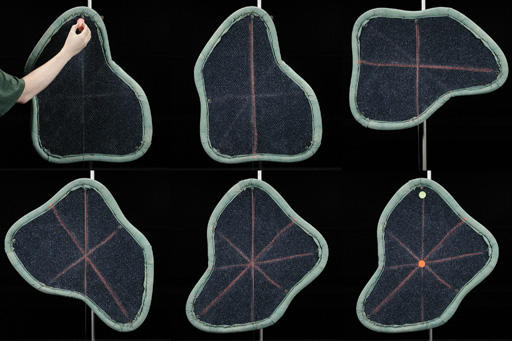
Locating the center of mass by suspension and plumb lines
For symmetric mass distributions:
- CM lies on any line of symmetry.
- Uniform density + one symmetry line → CM lies on that line.
- Multiple symmetry lines → CM at their intersection.
- Uniform sphere, disk, rod → CM at geometric center.
If density is nonuniform, symmetry might still help, but geometric center and CM may not match.
3. Calculating the Center of Mass
a. Discrete Particles
For point masses:
In components:
Same for .
How to actually do it:
- Add all masses → total mass .
- Compute the weighted sum .
- Divide by total mass.
The CM is always closer to the larger mass. If one mass dominates, the CM is near it.
This shows up in multi-particle momentum problems all the time.
b. Continuous Mass Distributions
When mass is spread out, sums become integrals:
You must express using a density.
Linear object (rod)
Linear density:
So:
Then:
2D or 3D object
- Surface density
- Volume density
Total mass:
On AP FRQs, the most common move is forgetting to compute total mass in the denominator. Always integrate numerator and denominator separately.
Choose coordinates that match symmetry. It makes the integral easier and often shorter.
4. Motion of the Center of Mass
The center of mass obeys Newton’s 2nd law:
Internal forces cancel. Always.
Consequences:
- If net external force is zero → constant CM velocity.
- Even if parts move wildly (explosion, collision), CM motion depends only on external forces.
This lets you replace a complicated system with:
- A point mass
- Located at
- With total mass
You do this constantly in:
- Projectile motion
- Collisions
- Orbital problems
- Momentum conservation setups
The exam loves scenarios where parts separate but the CM follows a simple path. If gravity is the only external force, the CM follows normal projectile motion, even if pieces scatter.
