Topic 2.7 Notes – Kinetic and Static Friction
1. What Friction Is
Friction is a contact force that acts parallel to the surfaces in contact and opposes relative motion or attempted relative motion.
- It only exists when two surfaces touch.
- It always appears in a free-body diagram (FBD) along the surface.
- On AP problems, we ignore microscopic details and use coefficients.
Friction depends directly on the normal force , which is the perpendicular force a surface exerts on an object.
A quick normal force refresher:
- Horizontal surface, no vertical acceleration
- Incline at angle
- If other vertical forces exist, use
The normal force is not automatically equal to . That mistake shows up constantly on tests, especially with angled pushes or inclines.
2. The Two Types of Friction
Static Friction
Static friction acts when surfaces are not moving relative to each other.
Its key feature is that it is self-adjusting. It takes whatever value is needed to prevent slipping, up to a maximum:
The maximum value is
Important ideas:
- If required friction < , the object stays at rest.
- If required friction exceeds , slipping begins.
- Direction is opposite the impending motion, not automatically opposite an applied force.
- Typically, .
That last point explains why starting motion feels harder than keeping something sliding.
Kinetic Friction
Kinetic friction occurs when surfaces slide relative to each other.
Its magnitude is fixed for given surfaces:
Key properties:
- Direction is opposite the relative velocity between surfaces.
- It does not depend on contact area.
- depends only on the materials in contact.
- The normal force is perpendicular to the surface and directed away from it.
Students often expect friction to change with surface area. On the AP exam, it does not.
Static vs. Kinetic at a Glance
| Static Friction | Kinetic Friction | |
|---|---|---|
| When it acts | No slipping | Sliding occurs |
| Magnitude | Adjustable up to | Exactly |
| Coefficient size | Larger | Smaller |
Once motion begins, friction usually drops from to . That drop can cause sudden acceleration.
3. Setting Up Friction Problems
Friction problems are just Newton’s Second Law with careful bookkeeping.
Free-Body Diagram
Here’s what a typical incline situation looks like. The block is on a ramp at angle , with gravity resolved into components parallel and perpendicular to the surface.
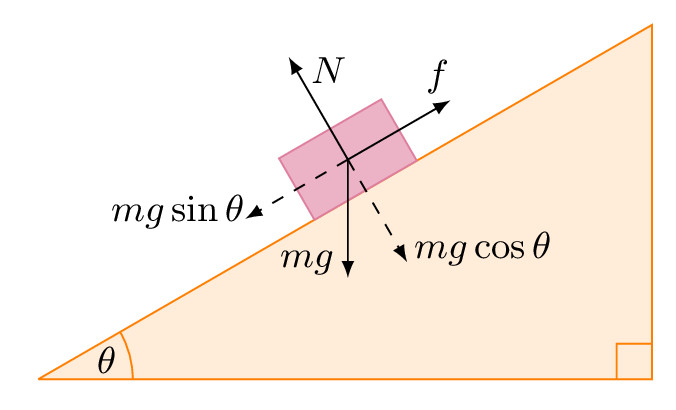
Free-body diagram for a block on an incline
Always include:
- straight down
- perpendicular to surface
- Friction parallel to surface
- Any applied forces or tension
Solve in This Order
- Decide motion state
- Sliding → use .
- Not sliding → use static model and check inequality.
- Find using perpendicular forces.
- Apply along the surface.
For static cases, solve for the required . Then check:
- If , no motion.
- If , switch to kinetic friction.
On FRQs, forgetting to check that inequality costs easy points.
4. Friction on Inclines and Angled Forces
On an incline:
- Parallel component of weight:
- Normal force:
At the threshold of motion:
So,
That relationship shows up in conceptual multiple choice. If you increase , you increase the tendency to slip because increases while decreases.
Pulling or Pushing at an Angle
An angled applied force changes :
- Pulling upward reduces → reduces friction.
- Pushing downward increases → increases friction.
Always recompute before plugging into . Many mistakes come from assuming when it isn’t.
