Topic 6.3 Notes – Angular Momentum and Angular Impulse
1. Angular Momentum
Angular momentum tells you how hard it is to change an object’s rotational motion. It depends on how mass is distributed and how fast it’s moving or rotating.
a. Rigid Body Rotating About a Fixed Axis
For something like a disk, rod, or wheel spinning about a known axis:
- = moment of inertia (how mass is spread relative to axis)
- = angular velocity
- Units:
If either or increases, angular momentum increases.
Direction follows the right-hand rule, same as angular velocity. Curl your fingers in the direction of rotation. Your thumb points along the angular momentum vector.
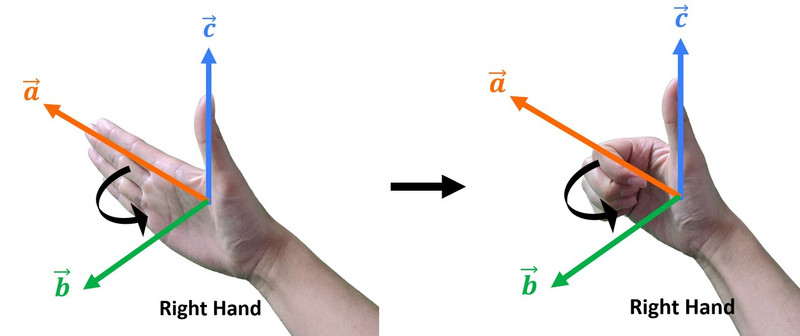
Right-hand rule for rotational direction
If the axis changes, the moment of inertia changes, and so does . On free-response questions, they love asking what happens when mass moves closer to or farther from the axis. You should instantly think about how that changes , and therefore .
b. Single Particle About a Point
For a particle or object moving in space, angular momentum is defined relative to a chosen point:
- = position vector from reference point
Magnitude:
- = angle between and
What controls the size of ?
- Mass
- Speed
- Distance from the reference point
- Angle between and
The direction of again comes from the right-hand rule. Point your fingers along , curl them toward , and your thumb gives the direction of , perpendicular to the plane formed by and .
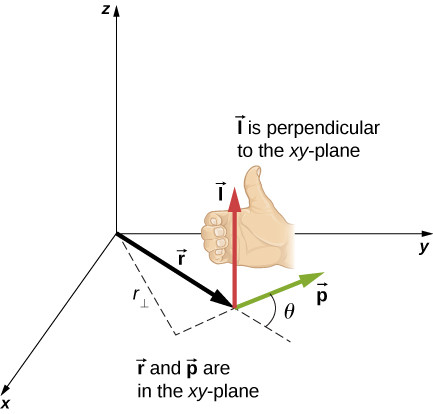
Angular momentum of a single particle about a point
Two important cases:
- Motion perpendicular to : , maximum angular momentum.
- Motion directly toward or away from point: , so .
The reference point matters. The same moving object can have different angular momentum depending on where you measure it from. That’s a common conceptual trap on multiple choice.
2. Angular Impulse
Torque changes angular momentum over time. The accumulated effect is angular impulse.
If torque is constant:
Units are , which match .
Direction matches the torque direction (again, right-hand rule).
Torque-Time Graphs
Area under a vs. graph gives angular impulse. For a constant torque between and , the area is a rectangle with height and width .
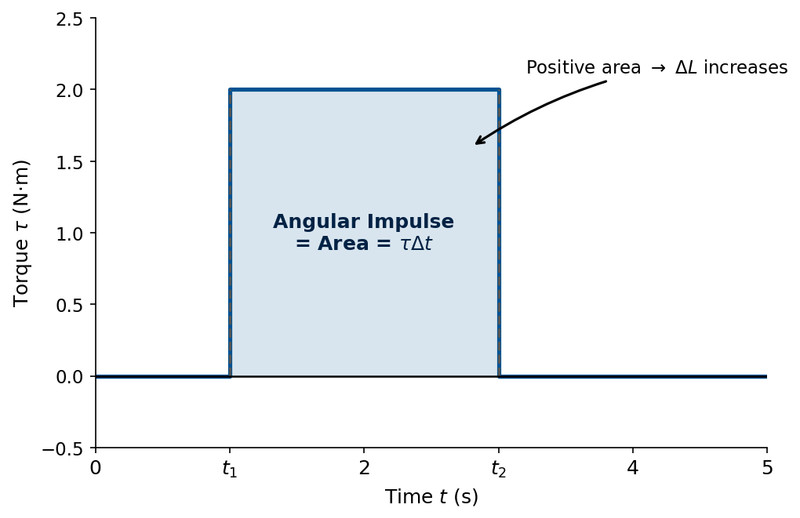
Torque vs. time graph showing angular impulse as area
- Positive area → angular momentum increases.
- Negative area → angular momentum decreases.
When you see a torque-time graph, think “area equals change in .” Just like force-time graphs from earlier units.
3. The Rotational Impulse-Momentum Theorem
This is the core equation:
Angular impulse equals the change in angular momentum.
It mirrors the linear version:
- Linear:
- Rotational:
If a wheel starts from rest and experiences a constant torque, you can go:
- Compute angular impulse .
- Set that equal to .
- Use to find final .
That sequence shows up constantly on quizzes.
4. Torque as a Rate of Change of Angular Momentum
Newton’s second law in rotational form:
If is constant:
This is where everything connects:
- Net torque equals the rate of change of angular momentum.
- Zero net torque means angular momentum stays constant.
Graph connections:
| Graph | Physical Meaning |
|---|---|
| Slope of L vs t | Net torque |
| Area under τ vs t | Change in angular momentum |
On FRQs, if they show you an vs. graph, the slope tells you torque immediately. No extra physics needed.
