Topic 6.4 Notes – Conservation of Angular Momentum
Angular Momentum of a System
Angular momentum measures rotational motion about a specific axis. Change the axis, and you change the angular momentum.
Single particle
For one particle moving relative to an origin,
- Direction from the right-hand rule (perpendicular to the plane of and ).
- Magnitude .
- Units: kg·m²/s.
The diagram below shows the geometry for a particle moving in the -plane. The angular momentum vector points perpendicular to that plane according to the right-hand rule.
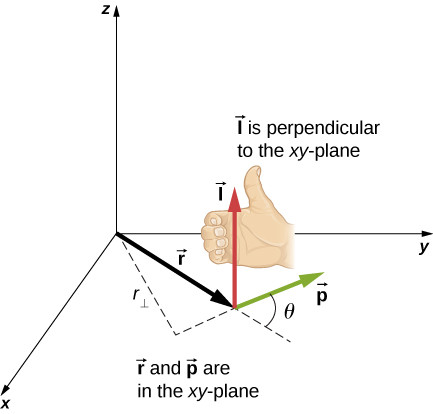
Angular momentum of a single particle
If motion is circular, , so .
Rigid body about a fixed axis
For rotation about a principal axis,
This is the form you’ll use most on AP problems.
System of objects
Total angular momentum is the sum about the same axis:
You can mix forms. A rotating disk uses , a flying lump of clay uses . Just be consistent about the axis.
When Angular Momentum Is Conserved
Rotation’s version of Newton’s second law is
And over time,
That integral is the angular impulse.
So:
- If net external torque = 0, then .
- If not, angular momentum changes by the angular impulse.
Two big ideas that show up on tests:
- Only external torques change total angular momentum.
- Internal torques between parts of your system cancel in pairs (Newton’s third law).
If object A twists on B, A gains angular impulse in one direction and B gains the same amount in the opposite direction. For the combined system, those cancel. Angular momentum is conserved in all interactions. Whether your chosen system shows conservation depends on what you included.
Choosing the System and the Axis
This is where most mistakes happen.
Angular momentum can be constant if:
- You include all interacting objects.
- The net external torque about your chosen axis is zero.
A smart move is picking an axis where unknown forces produce zero torque.
Example: a rod pivoted at one end.
- The hinge force passes through the pivot.
- Its lever arm is zero.
- So it produces zero torque about that point.
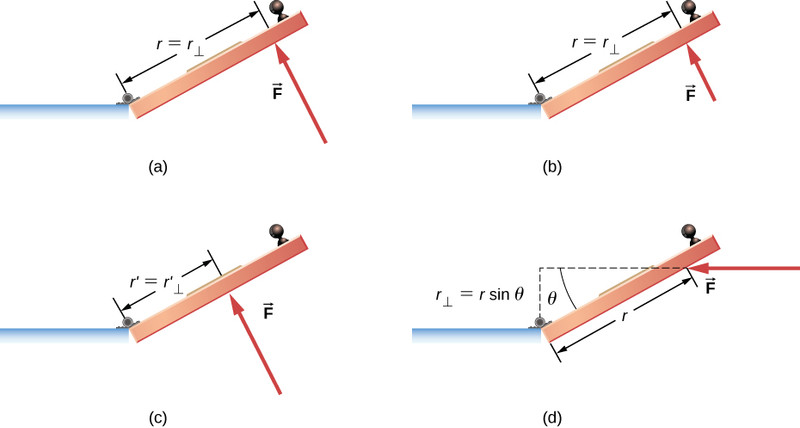
In each panel, the torque depends on the perpendicular distance from the pivot to the force’s line of action. When that perpendicular distance is zero, the torque is zero, even if the force itself is large.
That’s why so many collision-with-a-pivot problems use the pivot as the axis. You eliminate messy forces instantly.
If there is an external torque, then angular momentum is transferred between system and environment. The change in equals the angular impulse from outside.
Changing Moment of Inertia in Nonrigid Systems
If no external torque acts,
When mass moves closer to the axis, decreases and increases.
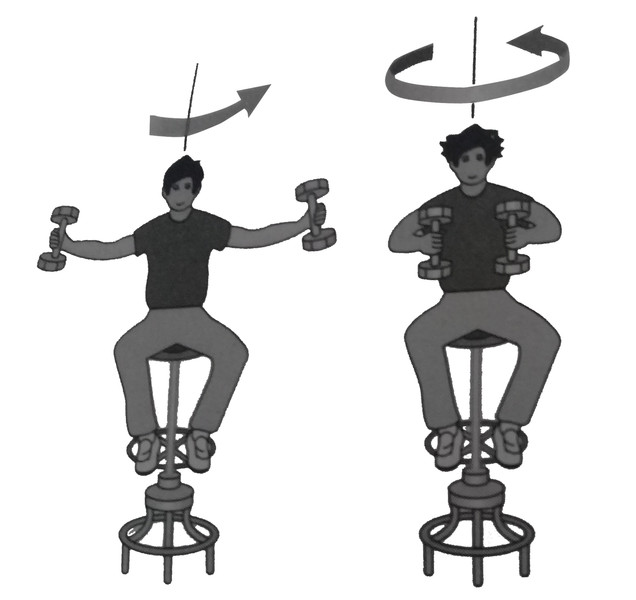
Changing moment of inertia on a rotating stool
In the illustration above, the person spins faster after pulling the dumbbells inward because the moment of inertia decreases while angular momentum stays constant.
This shows up constantly:
- Person on stool pulling dumbbells inward.
- Star collapsing and spinning faster.
- Ice skater pulling arms in.
One subtle but important point: rotational kinetic energy changes even though angular momentum does not. The person pulling masses inward does work. Conservation of angular momentum does not guarantee conservation of energy.
Solving Conservation Problems
No external torque
- Define the system.
- Choose the axis.
- Check that net external torque about that axis is zero.
- Write .
- Expand using or .
Common case: a lump of putty sticks to a spinning disk. You write
External torque present
- Calculate angular impulse (or if constant).
- Use .
- Convert back to with .
This is how motors spin up wheels or friction slows rotation over time.
