Topic 7.3 Notes – Representing and Analyzing SHM
1. What Simple Harmonic Motion Is
An object is in simple harmonic motion when its acceleration is proportional to its displacement from equilibrium and always points toward equilibrium.
Mathematically, that statement becomes:
That negative sign is everything. If is positive, acceleration is negative. If is negative, acceleration is positive. The system is always pulled back.
You’re not expected to prove the solution to this differential equation. You are expected to recognize that its solutions are sinusoidal:
Key quantities
- → amplitude (maximum displacement)
- → angular frequency (rad/s)
- → phase constant (sets initial conditions)
The natural frequency is the frequency a system oscillates at when displaced and released.
Examples:
- Mass-spring:
- Simple pendulum (small angles only):
If you ever see , you should immediately think SHM.
2. Displacement, Velocity, and Acceleration in SHM
Take the general position equation:
Everything else comes from derivatives.
Velocity
Maximum velocity:
This occurs at equilibrium where . The object is moving fastest as it passes the middle.
Acceleration
Since ,
This equation defines SHM.
Maximum acceleration:
This occurs at the turning points .
Zeros and Extrema
You should be able to recognize these instantly:
| Location | Displacement | Velocity | Acceleration |
|---|---|---|---|
| max/min | 0 | max magnitude | |
| 0 | max magnitude | 0 |
This shows up constantly in conceptual multiple choice and in FRQs where they ask what happens “at the instant the mass passes equilibrium.”
3. Phase and Graphical Representations
The motion is sinusoidal, but the three graphs are not identical. Compare how displacement, velocity, and acceleration line up in time below.
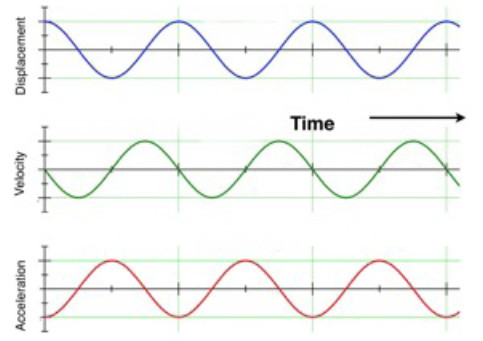
Displacement, velocity, and acceleration vs. time in SHM
Phase relationships
- Velocity is () out of phase with displacement.
- Acceleration is () out of phase with displacement.
- When is max →
- When → is max
- When →
If you’re given only a graph, you should be able to determine:
- Amplitude from vertical height
- Period from one full cycle
- Frequency from
- Angular frequency from
Also, the slope of an vs. graph gives velocity. Positive slope means moving in the + direction.
4. Amplitude and Period
One of the most tested conceptual ideas:
Changing amplitude does not change period in ideal SHM.
For example:
Amplitude is not in either formula.
If amplitude increases:
- increases because
- increases because
- Period stays the same
This is often hidden in lab-style questions where they change how far something is pulled back.
5. Resonance and Driven Oscillations
If a sinusoidal external force drives the system, the behavior depends on frequency.
Resonance occurs when the driving frequency equals the natural frequency.
At resonance:
- Energy transfer is maximized.
- Amplitude increases dramatically.
- Even a small force can produce large oscillations.
The system “builds up” motion because each push reinforces the motion at the perfect time.
If the driving frequency is far from natural frequency, oscillations stay small.
On free-response, you’re often asked to explain why amplitude increases. The correct reasoning always involves matching the driving frequency to the natural frequency and maximizing energy transfer.
