Topic 3.4 Notes – Conservation of Energy
1. Mechanical Energy
Mechanical energy is the energy a system has because of motion and position.
It only includes kinetic energy and potential energy. Not thermal, not sound. Just motion + interaction energy.
a. Kinetic Energy
Kinetic energy is energy of motion:
Key things you should instantly remember:
- Depends on mass and speed squared
- If speed doubles, increases by a factor of 4
- A system with only one object can only have kinetic energy
(No interactions → no potential energy)
If rotation shows up later in the course, rotational KE can also be part of , but here the core idea is translational .
b. Potential Energy
Potential energy exists when:
- Two objects interact via a conservative force, or
- An object can deform and return to shape (like a spring)
Common forms you’ll use:
- Gravitational near Earth:
- Spring:
Two big ideas students miss:
- Potential energy belongs to the system, not a single object.
A “ball at height h” only has gravitational PE if Earth is part of the system. - The zero of potential energy is arbitrary. Only changes in matter.
Here’s the classic energy exchange example. As the pendulum swings, energy continuously shifts between gravitational potential energy and kinetic energy.
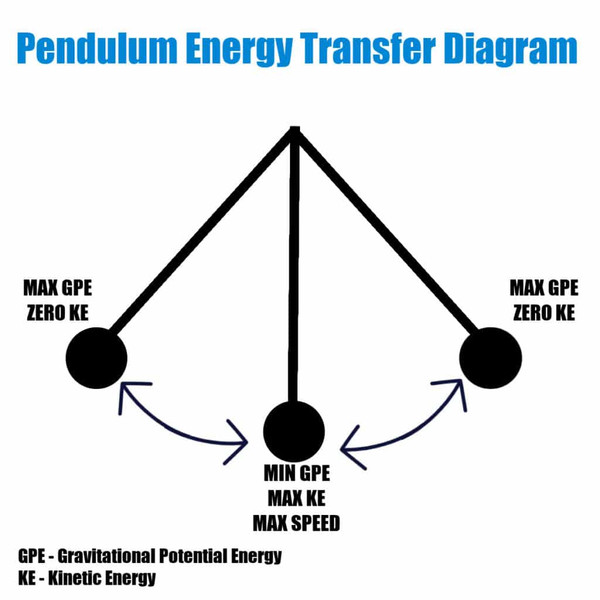
Energy transfer in a simple pendulum
At the highest points of the swing: , is maximum.
At the lowest point: is minimum, is maximum and the speed is greatest.
Total mechanical energy stays constant if no friction acts.
2. Conservation of Mechanical Energy
Mechanical energy is conserved only if:
- No external work is done on the system, and
- No nonconservative forces act inside it.
If that’s true:
or
Energy just shifts between forms.
When Nonconservative Forces Act
If friction or air resistance is involved:
- → mechanical energy increases
- → mechanical energy decreases
Friction converts mechanical energy into thermal energy or sound.
Mechanical energy isn’t conserved, but total energy still is.
On tests, friction problems often expect you to recognize that the “missing” mechanical energy became thermal.
Energy Crossing the System Boundary
If external work is done:
Positive work adds energy to the system.
Negative work removes it.
Any change in total system energy equals energy transferred across the boundary. Always.
3. Choosing the System Determines What Changes
Energy is conserved in all interactions. What changes is what you include in your system.
Case 1: Only Conservative Forces, No External Work
Example: block + Earth falling without air resistance.
Mechanical energy is constant.
Case 2: Nonconservative Forces Inside the System
Example: block sliding with friction.
- If system = block + Earth
→ mechanical energy decreases (thermal not included) - If system = block + Earth + floor + thermal energy
→ total energy constant
Your system choice controls what appears “lost.”
Case 3: External Work
Example: you lift a box.
- System = box + Earth
→ your force is external
→ work you do increases system energy - System = box + Earth + you
→ chemical energy in you decreases
→ gravitational potential increases
Same physics. Different accounting.
On FRQs, defining the system clearly can be the difference between full credit and confusion.
4. Applying Conservation of Energy
When solving problems:
- Define the system.
- Ask:
- Any nonconservative forces?
- Any external work?
- Write the correct energy equation.
- Substitute:
- Solve algebraically.
Energy methods are powerful because you skip forces and acceleration entirely. Many AP questions are designed so energy is faster than Newton’s second law.
