Topic 2.10 Notes – Circular Motion
1. What Makes Motion Circular
If an object moves in a circle, its velocity vector is always tangent to the circle. As it turns, that direction changes continuously. Since acceleration is the rate of change of velocity, circular motion always involves acceleration.
Centripetal Acceleration
“Centripetal” means center-seeking.
- Points toward the center (radial direction).
- Perpendicular to the instantaneous velocity.
- Exists even when speed is constant.
Magnitude:
Key patterns:
- Double the speed → acceleration increases by a factor of 4.
- Smaller radius → larger centripetal acceleration.
The diagram below shows the velocity vectors tangent to the circle and the centripetal acceleration vectors pointing inward at several positions.
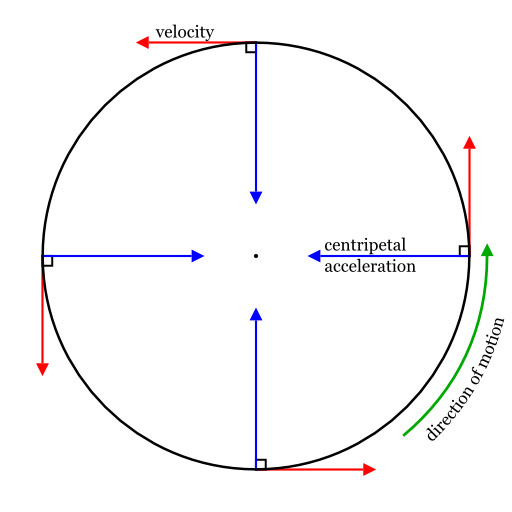
Velocity and centripetal acceleration in circular motion
If something is moving in a circle, there must be a net inward acceleration.
Tangential Acceleration
This is the acceleration that changes speed.
- Points tangent to the circle (same direction as velocity if speeding up).
- If , speed is constant → uniform circular motion.
- If , speed increases or decreases.
Net Acceleration
Centripetal and tangential accelerations are perpendicular. So the magnitude of total acceleration is:
In uniform circular motion, .
On FRQs, they love giving you both components and asking for the total magnitude or direction. Draw the perpendicular components. Don’t try to reason it out in your head.
2. Forces That Cause Circular Motion
There is no special “centripetal force.” The inward acceleration comes from real forces.
Always apply Newton’s 2nd Law in the radial direction:
You decide what counts as positive inward or outward, then stick with it.
Single Force Example
Satellite in circular orbit:
- Only force is gravity.
- Gravity provides the centripetal force.
You set and solve.
Minimum Speed at the Top of a Vertical Loop
At the top:
- Gravity points toward the center.
- Normal force also points toward the center if contact exists.
Minimum speed occurs when the object is just about to lose contact, so:
- Only gravity provides centripetal force.
If the speed is lower, the track can’t pull the object inward.
Banked Curves
For a car on a banked turn, resolve the normal force into vertical and horizontal components:
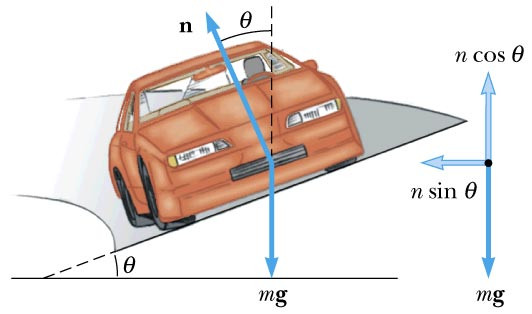
Forces:
- Weight downward
- Normal force perpendicular to surface
- Static friction along surface
The horizontal component of the normal force points toward the center of the circle and helps provide .
The vertical component balances weight if there’s no vertical acceleration.
At the ideal speed, friction is zero. The horizontal component of the normal force alone supplies the centripetal acceleration.
Conical Pendulum
Mass moves in a horizontal circle while string makes angle .
Forces:
- Tension
- Weight
Components:
The horizontal component of tension is the centripetal force.
3. Period and Frequency in Uniform Circular Motion
When speed is constant, it’s helpful to think in terms ofcycles.
Period
Time for one revolution.
Derived from distance per revolution .
Frequency
Revolutions per second.
You should be comfortable moving between , , , and . On multiple choice, they often hide the needed variable in one of these forms.
4. Circular Orbits and Kepler’s Third Law
For a satellite in circular orbit:
- Only force is gravity.
- That force supplies centripetal acceleration.
Set:
From there, using , you get:
Important ideas:
- Independent of satellite mass.
- Larger orbit radius → much longer period.
You are not expected to know Kepler’s 1st or 2nd laws here. Just this relationship for circular orbits.
