Topic 10.1 Notes – Electric Charge and Electric Force
1. What Electric Charge Is
Charge is a fundamental property of matter. If something has charge, it can exert and feel electric forces.
Two Types of Charge
- Positive (+)
- Negative (−)
The rule you’ve known since middle school still holds:
- Like charges repel
- Opposite charges attract
That attraction/repulsion is the electric force.
Elementary Charge and Quantization
The smallest unit of charge is the elementary charge, .
- Proton →
- Electron →
- Neutron →
All observable charge comes in integer multiples of . You can’t have 0.3e. That’s called quantization of charge.
On tests, if you’re given total charge and asked how many excess electrons that represents, you divide by . That’s it.
Point Charge Model
In AP Physics 2, most problems treat objects as point charges.
A point charge means:
- The object’s size is negligible compared to the distance between objects.
- We treat all its charge as concentrated at a single point.
If two small spheres are 2 m apart, modeling them as point charges is reasonable. If they’re 2 mm apart and large, that model breaks down.
2. Coulomb’s Law and the Electric Force
Coulomb’s law gives the magnitude of the electric force between two point charges.
Where:
- = magnitude of force
- = charges
- = distance between centers
What the Equation Is Saying
- Force is directly proportional to each charge.
- Force follows an inverse-square law in distance.
If:
- doubles → force becomes as large.
- One charge triples → force triples.
Students often forget the square on . That mistake destroys MCQ answers.
Direction of the Force
The force acts along the line connecting the charges.
Like charges push apart. Opposite charges pull together.
- Same sign → repulsive
- Opposite signs → attractive
Each charge feels the same magnitude force, opposite direction. That’s Newton’s 3rd law.
Multiple Charges and Superposition
With more than two charges:
- Calculate the force from each charge separately.
- Treat each as a vector.
- Add them vectorially.
AP limits you to four or fewer charges, unless symmetry makes it simpler. Always draw a force diagram first. It prevents sign and direction mistakes.
3. Electric Force vs Gravitational Force
Both are inverse-square forces. The equations even look similar:
Here’s how they compare:
| Electric Force | Gravitational Force |
|---|---|
| Depends on charge | Depends on mass |
| Can attract or repel | Always attractive |
| Extremely strong at particle scale | Extremely weak at particle scale |
Between elementary particles, electric force is enormously stronger than gravity.
Then why does gravity dominate planets and stars?
- Large objects are electrically neutral overall.
- Positive and negative charges cancel.
- Gravity only attracts, so it always adds up.
That’s a common conceptual FRQ prompt. Say “large-scale objects are electrically neutral, so electric forces cancel while gravitational forces accumulate.”
Electric Forces and Everyday Contact Forces
Normal force, friction, tension. All of these are actually due to electric interactions between atoms. We don’t calculate each microscopic electric force. We use contact force models instead. That’s why electric force is fundamental.
4. Electric Permittivity and Polarization
When charges are in a material instead of vacuum, the force changes.
Permittivity
Permittivity measures how a material responds to an electric field.
In free space:
Coulomb’s law becomes:
If is larger, the force is smaller.
Polarization
When an external electric field is applied:
- Electrons shift slightly relative to nuclei.
- Positive and negative charges separate slightly.
- No net charge is created.
That internal rearrangement is polarization.
The diagram shows an unpolarized atom on the left and a polarized atom on the right. The external charges distort the electron cloud, shifting it slightly relative to the nucleus and creating an induced dipole.
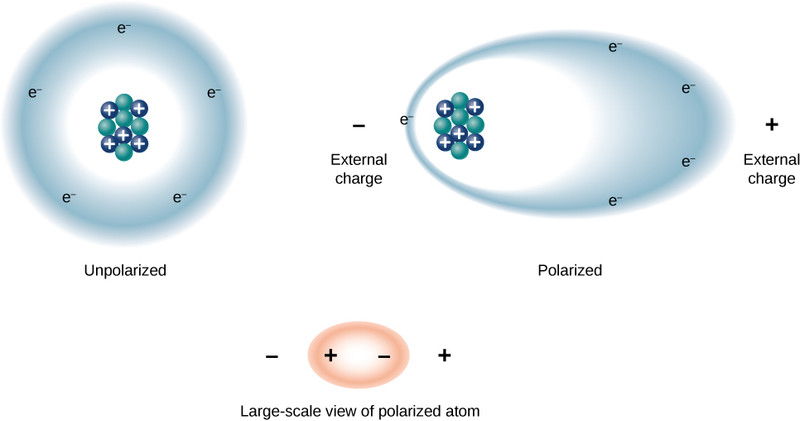
The induced charges create an internal field that partially opposes the external field. That reduces the effective force between charges inside the material.
Conductors vs Insulators
- Conductors
- Charges move freely.
- Strong rearrangement.
- Insulators
- Charges are bound to atoms.
- Only slight polarization.
Permittivity depends on how easily electrons can shift in the material.
