Topic 14.7 Notes – Diffraction
1. What Diffraction Is
Diffraction is the spreading of a wave as it passes through an opening or around an edge.
This happens for all waves:
- Light
- Sound
- Water waves
- Matter waves (like electrons)
The key idea is size comparison.
- If opening width → strong spreading
- If → wave spreads almost uniformly
- If → very little spreading
This is why low-frequency sound bends easily through doorways, but visible light does not. It also shows that light behaves like a wave, since particles alone would not spread this way.
Diffraction becomes visible because spreading waves from different parts of the opening interfere with each other.
2. Single-Slit Diffraction Setup and Geometry
Here’s the classic setup you’re expected to know. The diagram below shows the geometry that leads to the diffraction pattern on the screen.
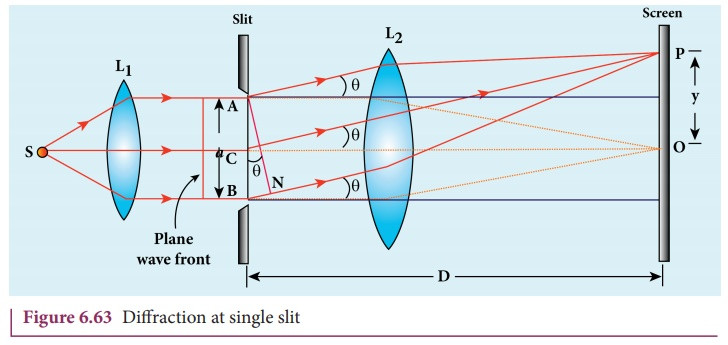
Single-slit diffraction geometry
You have:
- Monochromatic light of wavelength
- A slit of width
- A screen a distance away
- A diffraction pattern on the screen, with angle measured from the central axis
Why a Pattern Forms
By Huygens’ principle, every point across the slit acts like a tiny wave source.
Waves from the top and bottom of the slit travel slightly different distances to reach a point on the screen at angle . That difference is the path length difference .
- is measured from the central axis
- is the slit width
The amount of interference depends entirely on this .
3. Conditions for Dark and Bright Fringes
Dark Fringes (Minima)
Dark bands form when destructive interference occurs:
- There is no minimum
This formula is extremely testable.
For small angles (which AP almost always assumes):
Substitute into the condition:
This gives the distance from the center to the th dark fringe.
What Changes the Pattern?
From :
- Increase → fringes spread out
- Increase → fringes spread out
- Increase → fringes get closer together
Students often forget that bigger slit = narrower pattern. It’s inverse.
Bright Fringes
- The central maximum at is the widest and brightest.
- Secondary maxima are dimmer and narrower.
- You are not expected to memorize a formula for bright fringe positions.
4. What the Diffraction Pattern Looks Like
Here’s the intensity pattern you should recognize for a single slit. The top graph shows intensity versus angle, and the band below shows what you would see on the screen.
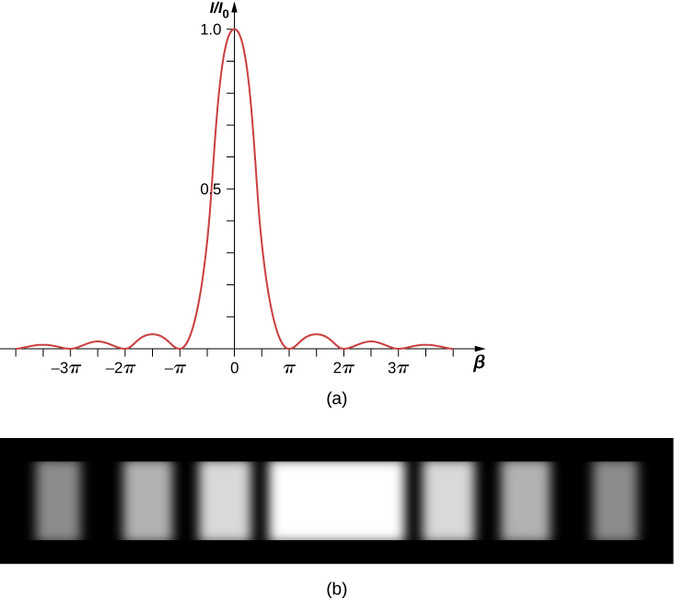
Single-slit diffraction intensity pattern
Key features:
- Very wide central bright fringe
- Alternating dark and dimmer bright bands
- Symmetry about the center
The width of the central maximum is proportional to .
If a question shows two patterns and asks which slit is narrower, look for the wider central maximum.
5. How Aperture Shape Affects the Pattern
The diffraction pattern depends on the shape of the opening.
- Single rectangular slit
- Fringes spread perpendicular to slit length
- Circular opening
- Bright central spot (Airy disk)
- Concentric rings
- Double slit
- Evenly spaced interference fringes
- Intensity modulated by a single-slit envelope
- Diffraction grating
- Very sharp, bright maxima at specific angles
On exams, they love giving you a pattern and asking what kind of aperture produced it. The wide central maximum is the giveaway for a single slit.
Visual patterns are not decorative. You can use them to:
- Determine
- Determine
- Predict what happens if something changes
