Topic 15.4 Notes – Blackbody Radiation
1. What Blackbody Radiation Is
Any object with a temperature above 0 K has moving, vibrating charged particles (electrons, ions). Because accelerating charges produce electromagnetic waves, matter spontaneously converts some internal thermal energy into electromagnetic radiation.
This happens continuously. No trigger required.
The blackbody model
A blackbody is an ideal object that:
- Absorbs all incoming radiation (no reflection, no transmission).
- If it’s in thermal equilibrium, it must emit energy at the same rate it absorbs it.
- Emits radiation that depends only on temperature, not material or shape.
Real objects approximate blackbodies. Stars are good examples.
The continuous spectrum
A blackbody emits a continuous spectrum, meaning it gives off radiation at a full range of wavelengths, not just specific lines.
We usually graph:
- Intensity (power per unit wavelength) on the y-axis
- Wavelength on the x-axis
For three different temperatures, the spectrum looks like this:
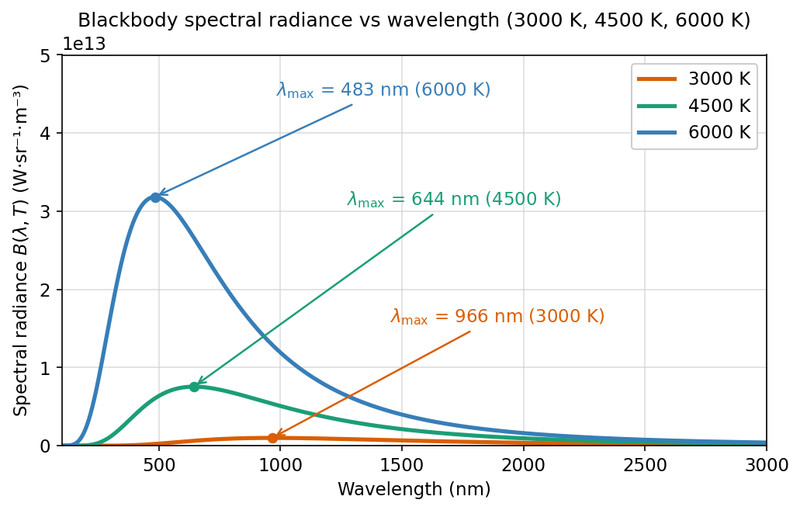
Blackbody spectral radiance vs. wavelength for 3000 K, 4500 K, and 6000 K
What you should notice:
- Each curve has one peak.
- Higher temperature →
- Taller curve (more energy overall)
- Peak shifts to shorter wavelengths (left).
That shape depends only on temperature.
2. The Blackbody Spectrum and Why Classical Physics Failed
What the graph tells you
For a fixed temperature:
- There is a peak wavelength where intensity is maximum.
- Intensity drops off at both longer and shorter wavelengths.
- The area under the curve represents total power emitted.
When temperature increases:
- Intensity increases at every wavelength.
- The peak moves to shorter wavelengths.
- Total emitted power increases dramatically.
The ultraviolet catastrophe
Classical physics (Rayleigh-Jeans law) predicted:
- Intensity should increase without limit at very short wavelengths.
- That would mean infinite energy emitted.
Clearly not physical. Experiments showed intensity actually drops off at short wavelengths.
This mismatch is called the ultraviolet catastrophe.
If you see a question asking why classical physics failed, the key idea is this: classical theory assumed energy could vary continuously and be shared equally among modes. That prediction did not match experimental data at short wavelengths.
Planck’s quantum solution
Max Planck proposed that energy is emitted in discrete packets, called quanta.
The energy of a photon is:
- = Planck’s constant
- = frequency
Because high-frequency light requires larger energy packets, it’s harder to emit. That naturally limits intensity at short wavelengths and fixes the ultraviolet catastrophe.
This is one of the first major steps into quantum physics.
3. Wien’s Law
Wien’s displacement law tells you where the peak occurs:
- = peak wavelength
- = temperature (Kelvin only)
Main idea: Peak wavelength is inversely proportional to temperature.
| Temperature | Peak Wavelength | Color Trend |
|---|---|---|
| Lower T | Longer λ | Red/infrared |
| Higher T | Shorter λ | Blue/UV |
So as objects get hotter:
- Red hot → orange → yellow → white → bluish.
On a quiz, if temperature doubles, the peak wavelength is cut in half. That inverse relationship is tested a lot.
Remember this law applies only to the location of the peak, not total energy.
4. Stefan-Boltzmann Law
Total power emitted across all wavelengths is:
- = total radiated power
- = surface area
- = Kelvin
Two big relationships:
- Power ∝ surface area
- Power ∝ temperature to the fourth power
If temperature doubles:
So power increases by a factor of 16.
That fourth power is huge. Small temperature increases cause massive increases in emitted energy. This is why slightly hotter stars are much more luminous.
This law is about total radiation, not just visible light.
5. How to Analyze Problems
When you see a blackbody question:
- Peak wavelength? → Use Wien’s law.
- Total emitted power? → Use Stefan-Boltzmann.
- Conceptual graph shift? → Hotter = taller curve, left shift.
Always:
- Convert temperature to Kelvin.
- Keep track of inverse vs fourth-power relationships.
- Use physical reasoning in explanations. For example: “As temperature increases, the peak wavelength decreases because .”
FRQs often ask you to describe how the graph changes when temperature increases. Mention both:
- Shift to shorter wavelength
- Increase in total emitted power (greater area under curve)
