Topic 9.6 Notes – Entropy and the Second Law of Thermodynamics
1. What Entropy Is
Entropy (S) measures how dispersed energy is within a system.
Think of it this way:
- High entropy → energy is spread out, more random, less available to do useful work.
- Low entropy → energy is concentrated, more ordered, more available to do work.
Another lens that shows up on FRQs: entropy tells you how much of a system’s energy is unavailable for work.
Energy Naturally Spreads Out
A core pattern you must recognize:
- Localized energy tends to disperse.
- Heat flows from hot → cold until temperatures are equal.
Here’s the classic example of conduction between a warmer and cooler object:
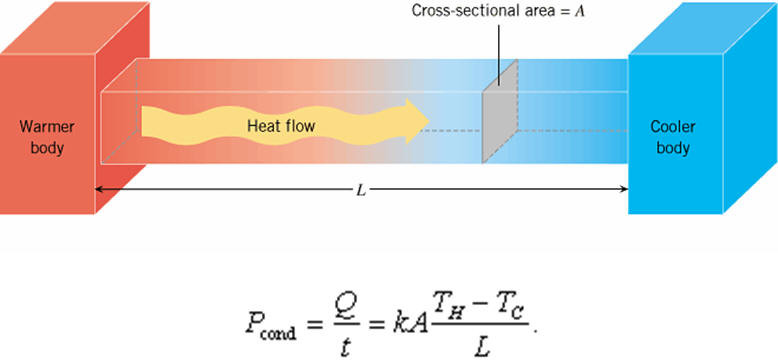
Heat conduction from a warmer body to a cooler body
As energy spreads from the hot block into the cold one:
- The temperature difference shrinks.
- The energy becomes more evenly distributed.
- Total entropy increases.
That “spreading out” idea is the heartbeat of this whole topic.
Entropy Is a State Function
Entropy depends only on the current state of the system (temperature, pressure, volume, configuration).
- It does not depend on how the system got there.
- Only initial and final states determine .
You will not calculate entropy numerically in AP Physics 2. You just decide whether it increases, decreases, or stays the same.
Maximum Entropy and Equilibrium
Entropy is maximum at thermodynamic equilibrium.
At equilibrium:
- No net energy transfer
- No macroscopic changes
- Energy is as evenly spread out as possible
Once a system reaches equilibrium, its entropy stops changing.
2. The Second Law of Thermodynamics
The second law says:
The total entropy of an isolated system can never decrease.
More specifically:
- It increases for real (irreversible) processes.
- It stays constant only for perfectly reversible processes (idealized).
This law explains why processes have a direction.
Heat flows hot → cold on its own.
Cold → hot requires external work.
If you’re ever asked whether something is spontaneous, your mental question is:
Does total entropy increase?
If yes, the process can occur naturally.
3. Types of Systems and Entropy Behavior
How entropy behaves depends on what can cross the system boundary.
| System Type | Energy Transfer? | Matter Transfer? | Entropy Behavior |
|---|---|---|---|
| Isolated | No | No | Total entropy never decreases; increases until equilibrium |
| Closed | Yes | No | System entropy can decrease, but total (system + surroundings) increases |
| Open | Yes | Yes | System entropy can decrease; surroundings increase more |
Isolated Systems
- No energy in or out.
- No matter in or out.
- Spontaneously move toward equilibrium.
- Entropy increases until equilibrium, then stays constant.
If two objects at different temperatures sit inside an insulated container, total entropy must increase as they equalize.
Closed Systems
- Energy can cross.
- Matter cannot.
The system’s entropy can decrease if energy leaves.
Example: a sealed container of warm water cooling in a room.
- Water entropy decreases as it cools.
- Room entropy increases by more.
- Total entropy increases.
The second law always applies to the isolated combination of system + surroundings.
Open Systems
- Both energy and matter can cross.
The system’s entropy can decrease.
Example: a refrigerator cooling food.
- Food entropy decreases.
- The room gains even more entropy from expelled heat.
- No violation of the second law.
This logic often appears in paragraph-style questions. You must mention surroundings.
4. Reasoning Through Entropy Changes
When you’re given a scenario, move through it like this:
- Identify the system type.
- Track energy flow (heat in or out?).
- Ask whether energy is becoming more spread out.
- Decide how entropy changes.
Situations to Recognize Quickly
- Hot object + cold object in contact (isolated)
→ total entropy increases. - Approaching thermal equilibrium
→ entropy increases until equilibrium, then remains constant. - Increasing temperature difference (by doing work)
→ local entropy decreases, but surroundings increase more.
5. Entropy and Ability to Do Work
When entropy increases:
- Energy becomes more dispersed.
- Less energy is available for useful work.
Temperature differences are a source of usable energy. A heat engine works only because there is a hot reservoir and a cold reservoir.
As temperatures equalize:
- Entropy increases.
- The ability to extract work disappears.
Energy is conserved by the first law.
Its usefulness is limited by the second law.
