Topic 9.1 Notes – Kinetic Theory of Temperature and Pressure
1. What Kinetic Theory Says About Gases
Think of a gas as an enormous number of tiny particles:
- In constant, random motion
- Colliding with:
- Other particles
- The walls of the container
- Modeled as having elastic collisions (total kinetic energy conserved in each collision)
Each individual collision is tiny. But there are astronomically many of them every second. Together, they produce measurable effects.
Two big connections to lock in:
- Pressure comes from momentum transfer during collisions.
- Temperature measures the average kinetic energy of the particles.
So we’re translating microscopic motion → macroscopic quantities.
2. How Atomic Collisions Create Pressure
Momentum Transfer in Collisions
When a gas particle hits a wall:
- Its velocity component perpendicular to the wall reverses.
- That means its momentum changes.
- By conservation of momentum, the wall experiences an equal and opposite impulse.
Impulse equals change in momentum:
Bigger speed → bigger momentum → bigger change in momentum → larger force during collision.
More frequent collisions also increase total force.
On tests, you might be given a particle bouncing off a wall and asked to find force from momentum change per unit time. That’s straight conservation of momentum plus impulse.
Pressure as Force per Area
Pressure is defined as:
- is the sum of the perpendicular components of force.
- is surface area.
- Units: pascals (Pa) = N/m².
Only the perpendicular component matters. A particle sliding along the wall doesn’t contribute to pressure.
Pressure increases if:
- Collisions happen more often
- Collisions involve larger momentum changes
- The same force acts on a smaller area
That “perpendicular component” detail shows up in conceptual questions more than you’d expect.
Pressure Exists Throughout the Gas
Pressure is not just something at the walls.
- Particles collide with each other constantly.
- These collisions transmit forces throughout the gas.
- In a stationary gas, pressure acts equally in all directions at a point.
That’s why gases expand to fill containers and why pressure is uniform in a closed system at equilibrium.
If you’re asked to explain this in words, mention collisions between particles and transmission of force in all directions.
3. Temperature as Average Kinetic Energy
Temperature is about average translational kinetic energy per particle.
For an ideal gas:
- is the Boltzmann constant.
- must be in Kelvin.
Key implications:
- Higher → higher average particle speed.
- If average kinetic energy doubles, absolute temperature doubles.
- Temperature does not measure total kinetic energy of the whole sample.
- Temperature does not mean every particle has the same speed.
Students often mix up total energy and average energy per particle. The equation above is per particle.
4. The Maxwell-Boltzmann Distribution and rms Speed
Maxwell-Boltzmann Distribution
Here’s what particle speeds actually look like at different temperatures:
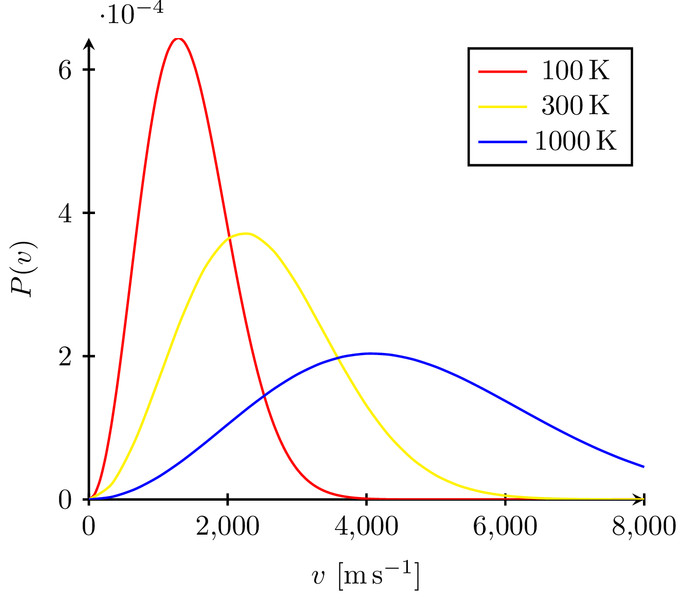
Maxwell-Boltzmann speed distributions at three temperatures
Each curve shows how many particles have a given speed. As you compare 100 K, 300 K, and 1000 K, notice how the peak shifts and the shape changes.
Important features:
- Speeds are spread out.
- There’s a most probable speed (the peak of each curve).
- A few particles move very fast.
- As temperature increases:
- The curve shifts to the right.
- The curve spreads out.
- More high-speed particles appear.
You are not expected to know the formula for the curve. Just understand how its shape changes with temperature.
Root-Mean-Square Speed
The rms speed connects temperature directly to speed:
- is the mass of one particle.
Key relationships:
-
- If temperature increases by a factor of 4, rms speed doubles.
- At the same temperature:
- Lighter particles move faster.
- Heavier particles move slower.
- Different gases at the same temperature have the same average kinetic energy, but different speeds.
That last point shows up a lot in multiple-choice questions.
5. Big Picture Connections for Test Questions
Keep this cause-and-effect chain in your head:
Temperature → kinetic energy → particle speed → momentum change → force → pressure
Examples you should be comfortable explaining:
- Increasing temperature at constant volume increases pressure because particles hit the walls harder and more frequently.
- Two gases at the same temperature have equal average kinetic energy even if their masses differ.
- Lighter gas molecules move faster at the same temperature because .
If you can explain those in complete sentences using momentum and energy language, you’re thinking at AP level.
