Topic 12.4 Notes – Electromagnetic Induction and Faraday’s Law
1. Magnetic Flux
Magnetic flux tells you how much magnetic field actually passes through a surface. It only depends on the component of B that is perpendicular to the surface.
- = magnetic field strength (tesla)
- = area of the surface
- = angle between B and the area vector
The Area Vector
Every surface has an area vector:
- It is perpendicular to the surface.
- For a closed surface, it points outward.
- Its direction determines the sign of flux.
If B is parallel to the area vector → flux is positive.
If B is opposite the area vector → flux is negative.
Units of flux: weber (Wb) = T·m².
In the diagram below, the magnetic field B points horizontally, and the loop’s normal vector N is shown at an angle . That angle between B and the normal is the used in .
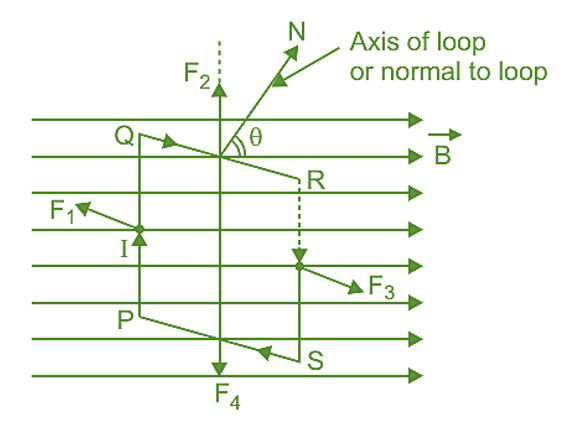
Rectangular loop in a uniform magnetic field showing the area (normal) vector
How Flux Changes
You can change magnetic flux in exactly three ways:
- Change the field strength
- Change the area
- Change the angle
If flux stays constant, nothing happens electrically. Induction only cares about change in flux.
2. Faraday’s Law and Induced emf
A changing magnetic flux produces an induced electric potential difference (emf).
- = induced emf
- = number of loops
- = rate of change of flux
For most AP problems, you’ll use the average form:
What this tells you:
- Faster change → larger emf
- More loops → larger emf
- No change in flux →
Physically, a changing magnetic field creates an induced electric field, which pushes charges around a loop. No battery needed.
A common mistake on tests is plugging into Faraday’s Law before checking whether flux is actually changing. Sometimes the field is strong but constant and the loop is fixed. That gives zero emf.
3. Lenz’s Law and Direction of Induced Current
The negative sign in Faraday’s Law leads to Lenz’s Law:
The induced current creates a magnetic field that opposes the change in magnetic flux.
It opposes the change, not necessarily the original field.
Applying Lenz’s Law
- Identify the direction of the external magnetic field.
- Decide whether flux is increasing or decreasing.
- Figure out what magnetic field would oppose that change.
- Use the right-hand rule to find the current direction.
Right-hand rule reminder:
- Thumb → direction of induced magnetic field
- Curled fingers → direction of current
If flux is increasing, the induced field opposes the external field.
If flux is decreasing, the induced field tries to reinforce it.
This is conservation of energy in action. If the induced current helped the change instead of opposing it, you’d get energy from nowhere.
Conceptual direction questions are extremely common on both class tests and AP multiple choice. Write your reasoning in full sentences if it’s FRQ-style.
4. The Moving Conducting Rod on Rails
This is the classic induction setup. A conducting rod slides along two rails in a uniform magnetic field directed into the page, with a resistor completing the circuit on the left.
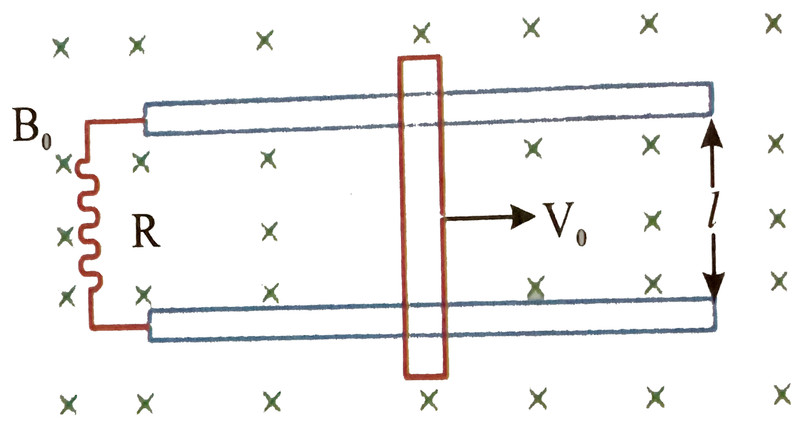
Moving conducting rod in a uniform magnetic field
As the rod moves to the right, the area of the loop increases, so magnetic flux through the loop changes.
For a rod of length moving at speed perpendicular to :
Why this works:
- Charges in the rod move with velocity .
- They feel magnetic force .
- Charges separate → potential difference forms.
If the circuit is closed:
- Current flows.
- The current-carrying rod feels magnetic force.
- That force opposes motion.
So an external force must pull the rod to keep it moving. Mechanical work becomes electrical energy, then thermal energy in the resistor.
Energy conservation shows up here all the time in free-response questions. Be ready to connect work, power, and induced current.
