Topic 15.5 Notes – The Photoelectric Effect
1. What the Photoelectric Effect Is
The photoelectric effect happens when electromagnetic radiation (light) shines on a photoactive material and electrons are emitted from its surface.
What’s physically happening:
- Light arrives as photons, each with energy where is Planck’s constant and is frequency.
- A single photon transfers its energy to a single electron.
- If the electron receives enough energy, it escapes the metal.
That “one photon → one electron” idea is huge. It tells us light behaves like a stream of particles, not just a continuous wave.
If light were purely a wave, energy would build up gradually. Instead, electrons are emitted instantly when the right frequency hits.
2. Threshold Frequency and Work Function
To understand when electrons are emitted, we need two ideas: work function and threshold frequency.
Work Function
The work function is the minimum energy required to remove an electron from a material.
- Symbol:
- Units: joules (J) or electron volts (eV)
- It depends on the material.
- Lower → electrons are easier to eject.
You won’t memorize work functions for specific metals. If needed, they’ll be given.
Threshold Frequency
The threshold frequency is the minimum frequency of light required to eject electrons.
It comes directly from setting photon energy equal to work function:
What this means:
- If → no electrons are emitted, even if the light is very bright.
- If → electrons are emitted, even if the light is dim.
That second bullet is where classical physics failed. Classical theory predicted that high enough intensity should eventually knock electrons loose at any frequency. That does not happen.
Frequency vs. Intensity
Students mix this up constantly. Keep the roles separate:
| What changes? | Frequency | Intensity |
|---|---|---|
| Whether electrons are emitted | Yes (must exceed ) | No |
| Maximum kinetic energy | Yes | No |
| Number of electrons emitted (current) | No | Yes |
- Frequency controls energy per electron.
- Intensity controls number of electrons.
On AP questions, if they double intensity but keep frequency the same, the kinetic energy does not change.
3. The Photoelectric Equation and Electron Energy
Energy is conserved in each interaction:
Break it down physically:
- Photon arrives with energy .
- is used to free the electron.
- Leftover energy becomes kinetic energy.
So:
- If , then . The electron barely escapes.
- If , the extra becomes kinetic energy.
- If , no emission at all.
This is why increasing frequency increases the maximum kinetic energy of emitted electrons.
4. The Photoelectric Effect Experiment
Here’s the standard setup used to study the photoelectric effect:
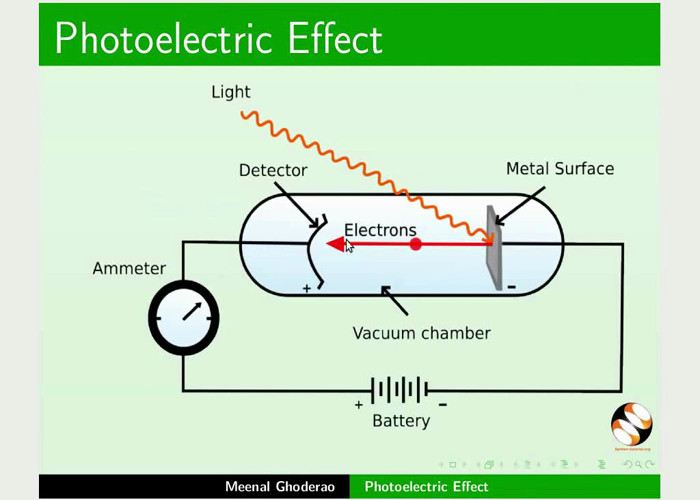
Photoelectric effect apparatus
Light shines onto a metal surface inside a vacuum tube. If the frequency is high enough, electrons are emitted and travel across the tube to the other plate, producing a measurable current in the external circuit.
What happens:
- Light hits one metal plate.
- Electrons are emitted.
- They travel to the other plate, creating current.
Stopping Potential
To measure the maximum kinetic energy, a reverse voltage is applied using the battery in the circuit.
- Increase the reverse voltage.
- At some voltage, the current drops to zero.
- That voltage is the stopping potential .
The reverse voltage creates an electric potential energy barrier that opposes the motion of the emitted electrons. When the current just reaches zero, even the fastest electrons have been stopped.
At this point:
For electrons:
So experimentally, you measure , calculate , and use to determine the work function.
On FRQs, you may be asked to explain how adjusting the voltage determines the maximum kinetic energy. Say that the stopping potential equals the electric potential energy needed to stop the fastest electrons.
5. Why the Photoelectric Effect Matters
The photoelectric effect proves:
- Light energy is quantized.
- Electron energy depends on frequency, not intensity.
- There is a minimum threshold frequency.
Classical wave theory could not explain:
- Instantaneous emission
- Existence of threshold frequency
- Kinetic energy depending only on frequency
Technologies built on this idea include solar cells and photodetectors, but for AP Physics 2 the focus is conceptual and mathematical understanding.
