Topic 10.7 Notes – Conservation of Electric Energy
1. Electric Potential Energy and Potential Difference
Electric potential is electric potential energy per unit charge.
- = change in electric potential energy (J)
- = charge (C)
- (V)
A volt is a joule per coulomb. So if the potential difference is 12 V, that means 12 J of energy per coulomb of charge.
What the equation is saying
- Potential difference tells you energy per charge.
- Multiply by the actual charge to get total energy change.
- Units check:
If a charge moves through a drop:
The system loses 10 J of electric potential energy.
Sign rules that matter
The sign of and the sign of both matter.
For a positive charge:
- Moving to higher potential →
- Moving to lower potential →
For a negative charge, it flips:
- Moving to higher potential →
- Moving to lower potential →
Think of potential like “electric height.” Positive charges naturally roll “downhill” toward lower potential.
2. Conservation of Electric Energy
Electric forces are conservative, just like gravity. That means total mechanical energy is conserved if only electric forces act.
So,
This is the core relationship for this topic.
What it means physically
- If electric potential energy decreases, kinetic energy increases.
- If electric potential energy increases, kinetic energy decreases.
- Energy changes form, but total stays constant.
This is exactly how:
- Electrons speed up in a vacuum tube
- Particles are accelerated in electric fields
- Charges gain energy moving across a battery
If a charge moves through a 300 V potential difference, the change in kinetic energy depends only on that 300 V, not on the path taken. That “path independence” is a huge clue you’re dealing with a conservative force.
3. How Charges Move in a Potential Difference
Direction of motion
Charges accelerate in the direction that lowers their electric potential energy.
- Positive charges accelerate toward lower potential
- Negative charges accelerate toward higher potential
Here’s the idea visually for a positive charge between two parallel plates:
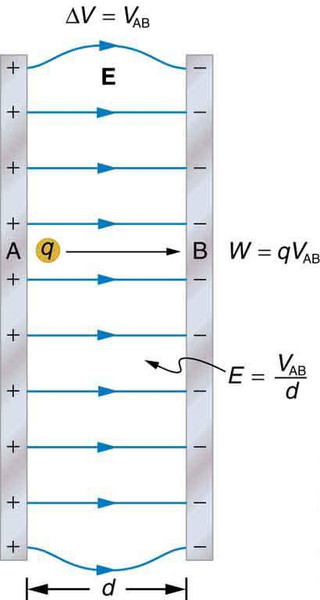
Positive charge moving between parallel plates
The left plate is positive and the right plate is negative, so the electric field points from left to right. That direction is from higher potential to lower potential, which is why a positive charge accelerates to the right. A negative charge would accelerate in the opposite direction.
Starting from rest
A very common setup: a particle starts at rest and moves through a potential difference.
Initial , so:
Then,
Example with different numbers than you’ve seen:
A charge (mass ) moves from 100 V to 40 V.
So kinetic energy increases by .
On an FRQ, you must clearly state that the decrease in electric potential energy equals the increase in kinetic energy due to conservation of energy.
When the charge slows down
If a charge moves in a way that makes , then kinetic energy decreases. If it doesn’t have enough initial kinetic energy, it will stop and reverse. That shows up in conceptual multiple choice questions a lot.
4. Strategy for Solving Problems
When you see a potential difference question:
- Identify with its sign.
- Compute .
- Use .
- Apply .
- If needed, connect to .
Common mistakes:
- Dropping the negative sign for electrons.
- Forgetting that potential difference is final minus initial.
- Mixing up potential (V) and potential energy (J).
