Topic 11.1 Notes – Electric Current
1. What Electric Current Is
At its core, electric current tells you how fast charge is flowing.
The definition is:
- = current (amperes, A)
- = charge (coulombs, C)
- = time (seconds, s)
1 ampere = 1 coulomb per second.
So if 5 C of charge pass through a wire in 2 s,
Notice what this does and doesn’t say:
- Current is about rate, not total charge sitting in the wire.
- It’s measured at a specific cross-section of the wire.
Here’s what that idea looks like. Focus on the circular slice labeled A, which represents the cross-sectional area where we measure current.
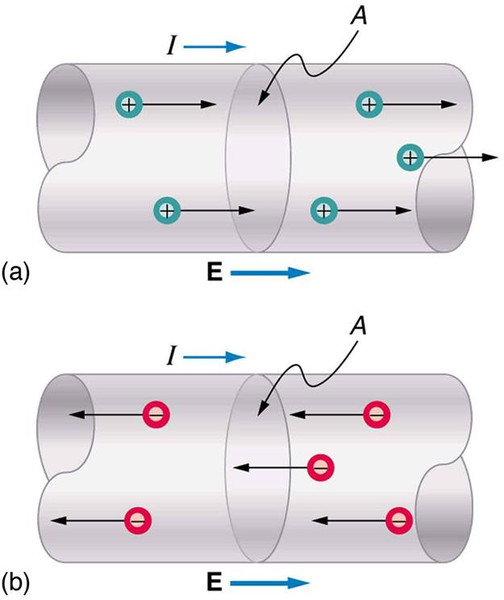
Current through a wire’s cross-sectional area
Imagine “freezing” time and counting how much charge passes through that slice each second. That’s current.
If more charge passes in the same time → bigger current.
If the same charge takes longer → smaller current.
In steady current, the same amount of charge passes every cross-section each second. That’s why current is the same everywhere in a simple series wire.
2. What Makes Charges Move - Electric Potential Difference (emf)
Charges don’t drift in one direction on their own. They need a push. That push is an electric potential difference, often called electromotive force or emf ().
- Provided by a battery or power supply
- Measured in volts (V)
- Creates an electric field inside the conductor
That electric field exerts a force on charge carriers (usually electrons in metal). The force causes a tiny average motion in one direction, which gives you current.
No potential difference → no net current.
A good physical way to say this on a test:
A potential difference creates an electric field in the wire, which exerts a force on charge carriers, causing a net drift of charge.
That cause-and-effect chain is something teachers and the AP exam like to see clearly explained.
3. How Charges Actually Move in a Wire
This is where students often get confused.
Random Thermal Motion
Even if current is zero:
- Electrons are still moving.
- They have random speeds due to thermal energy.
- Their motion is in all directions.
Zero current does not mean zero motion. It means zero net motion.
If you were asked to describe what happens when a switch is open, you’d say:
The net motion of charge carriers is zero, although individual charges continue random thermal motion.
That wording matters.
Drift Motion (Net Motion)
When a potential difference is applied:
- An electric field forms in the wire.
- Electrons gain a small average velocity opposite the electric field.
- This average velocity is called drift velocity.
The actual motion is:
random motion + small directional drift = current
The drift speed is surprisingly small, but the electric field is established throughout the circuit almost instantly, so current appears to start right away.
4. Current Direction - Conventional vs Electron Flow
Current is not a vector, but it does have a defined direction. That direction is based on charge flow, not coordinates.
Conventional Current
By definition, current points in the direction positive charge would move.
In a battery circuit:
- Conventional current flows from the positive terminal to the negative terminal through the external circuit.
Electron Flow
In metal wires:
- The actual moving charges are electrons.
- Electrons move from the negative terminal to the positive terminal.
- That is opposite conventional current.
Here’s the comparison clearly:
| Feature | Conventional Current | Electron Flow |
|---|---|---|
| Based on | Positive charge motion | Actual electrons |
| Direction in circuit | + → − terminal | − → + terminal |
| Used in equations? | Yes | No |
Every circuit rule you use later assumes conventional current. Stick with that unless the problem specifically asks about electrons.
5. Zero Current vs Nonzero Current
This distinction shows up in conceptual questions.
If Current = 0
- No net charge passes the cross-section per second.
- Drift velocity = 0.
- Charges still move randomly.
If Current ≠ 0
- There is a nonzero drift velocity.
- A steady amount of charge passes each cross-section per second (in steady state).
- A potential difference is present somewhere driving it.
If you’re asked to “describe the motion of charges,” make sure you clearly separate random motion from net drift. That’s where points are often lost.
