Topic 12.1 Notes – Magnetic Fields
1. What a Magnetic Field Is
A magnetic field is a vector field. That means:
- It has a magnitude and direction at every point in space.
- It determines the magnetic force on:
- Moving charges
- Current-carrying wires
- Magnetic materials
You already know electric fields can come from single charges. Magnetic fields are different.
No Magnetic Monopoles
Magnetic fields are produced by magnetic dipoles, never isolated poles.
A magnetic dipole has:
- One north (N) pole
- One south (S) pole
If you break a bar magnet in half, you don’t get a lone north pole. Each piece becomes a smaller dipole with its own N and S poles. This “no monopoles” idea is something teachers love to test conceptually.
Also:
- Like poles repel.
- Opposite poles attract.
- The magnetic field from a dipole gets weaker as you move farther away.
Representing Magnetic Fields
We draw magnetic fields using field lines. For a simple bar magnet, the pattern looks like this:
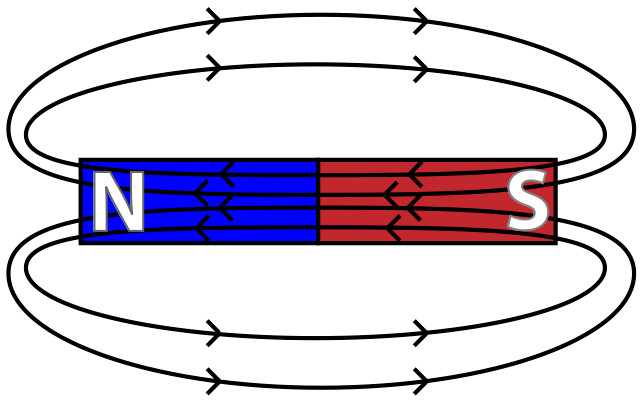
Magnetic field lines around a bar magnet
Important features:
- Field lines show the direction of .
- The direction of the field at any point is tangent to the line there.
- Denser lines = stronger field.
- Field lines form closed loops. They never start or end.
Outside a bar magnet:
- Field points away from the north pole
- Curves around
- Enters the south pole
Inside the magnet, the field continues from south to north, completing the loop.
That closed-loop property is a huge difference from electric fields.
2. Where Magnetic Dipoles Come From
At the atomic level, magnetic dipoles come from moving electric charges.
Main source:
- Electrons, because they:
- Move in orbit-like paths around nuclei
- Have intrinsic spin
Moving charge → magnetic field. When many atomic dipoles combine, you get visible magnetism.
Alignment and Magnetism
Magnetism depends on whether these tiny dipoles are aligned.
- Permanent magnetism
- Dipoles are aligned.
- They stay aligned even after the external field is removed.
- Induced magnetism
- An external magnetic field causes temporary alignment.
- Dipoles return to random orientation when the field is removed.
A magnetic dipole placed in a magnetic field experiences a torque that tries to rotate it so it lines up with the field.
That’s exactly how a compass works.
Earth’s Magnetic Field
Earth acts approximately like a giant magnetic dipole. Its field lines have the same overall shape as those around a simple bar magnet.
In the diagram, the globe on the left is shown with field lines looping around it, just like the labeled bar magnet on the right.
Compasses align with Earth’s magnetic field because the needle itself is a dipole that rotates to match the direction of .
3. Types of Magnetic Materials
How a material responds depends on how its atomic dipoles behave in an external field.
| Type | Dipole Behavior | Strength | Permanent? |
|---|---|---|---|
| Ferromagnetic (iron, nickel, cobalt) | Dipoles form domains that align strongly with external field | Strong | Yes, can remain magnetized |
| Paramagnetic (aluminum, titanium, magnesium) | Dipoles weakly align with external field | Weak | No |
| Diamagnetic (all materials) | Induced dipoles align opposite external field | Very weak | No |
A few things students mix up:
- Ferromagnetic materials have regions called magnetic domains. When those align, the material can become a permanent magnet.
- Paramagnetic materials are weakly attracted but don’t stay magnetized.
- Diamagnetism is always present but usually tiny. It causes weak repulsion.
If a question says a material remains magnetized after the field is removed, it must be ferromagnetic.
4. Magnetic Permeability
Magnetic permeability measures how much a material becomes magnetized in response to an external magnetic field.
It tells you how easily magnetic field lines pass through a material.
Vacuum Permeability
Free space has a constant called vacuum permeability:
You’ll see in many electromagnetic equations later. It’s universal.
Permeability of Materials
For real materials:
- is different from .
- It depends on:
- Material composition
- Internal dipole structure
- Temperature
- Field strength
- Orientation
High-permeability materials (like iron):
- Concentrate magnetic field lines.
- Used in transformer cores and shielding.
Low-permeability materials:
- Don’t significantly change the external field.
On conceptual questions, if field lines crowd inside a material, that material has high permeability.
