Topic 14.3 Notes – Boundary Behavior of Waves and Polarization
1. What Happens When a Wave Hits a Boundary
When a wave traveling in one medium reaches a different medium, the boundary usually causes two things at once:
- Part of the wave is reflected (stays in the original medium).
- Part is transmitted (enters the new medium).
This happens because wave speed depends on the medium (density, tension, elasticity, etc.).
Frequency, Speed, and Wavelength
One rule you absolutely need locked in:
- Frequency does not change at a boundary.
The source sets the frequency.
Wave speed often changes, so the wavelength must adjust:
At a boundary:
- may change
- changes accordingly
If the wave slows down in the second medium and frequency stays the same, the wavelength gets shorter.
This is a common AP trap. They’ll give you two media and ask which quantities change. Frequency stays the same. Speed and wavelength may change.
Energy is split between the reflected and transmitted waves. Bigger reflection means smaller transmission.
2. Reflection and Transmission at a Boundary
Reflected Waves and Inversion
For transverse waves (like pulses on a string), whether the reflected wave flips depends on the relative wave speeds.
Here’s the rule:
- If the transmitted wave speed decreases
→ Reflected wave is inverted (180° phase shift). - If the transmitted wave speed increases
→ Reflected wave is not inverted.
Picture a pulse traveling from a light string to a heavy string. The diagram shows the incident pulse, the inverted reflected pulse, and the transmitted pulse with a shorter wavelength in the slower medium.
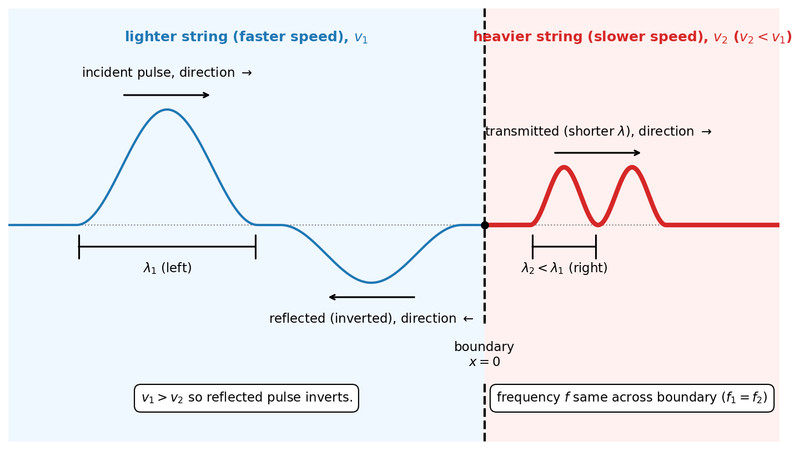
Reflection and transmission of a pulse at a string boundary
Light string → heavy string means slower speed in the second medium. The reflected pulse flips.
Heavy string → light string means faster speed in the second medium. The reflected pulse stays upright.
Students mix this up when they think “heavier means bigger flip.” Don’t memorize heavy/light. Think speed change.
Transmitted Waves
The transmitted wave:
- Has the same frequency
- Has a new speed
- Therefore has a new wavelength
- Usually has smaller amplitude (since some energy reflected)
On free-response questions, they often want a sentence like:
The frequency remains constant because it is determined by the source, while the wavelength changes due to the change in wave speed in the new medium.
Be ready to explain it in words, not just equations.
3. Polarization of Waves
What Polarization Means
Polarization restricts a wave’s oscillations to a single plane.
Only transverse waves can be polarized.
Why? Because transverse waves oscillate perpendicular to their direction of motion, and there are multiple perpendicular directions available.
Transverse vs Longitudinal Waves
| Property | Transverse | Longitudinal |
|---|---|---|
| Oscillation direction | Perpendicular to motion | Parallel to motion |
| Can be polarized? | Yes | No |
| Example | Light, string waves | Sound in air |
Sound waves in air cannot be polarized because their oscillations are along the direction of motion. There is no sideways component to restrict.
How Polarization Occurs
Transverse waves can become polarized by:
- Reflection
- Passing through polarizing filters
- Certain crystals or materials
- Scattering
Unpolarized light oscillates in many planes. After one polarizer, it oscillates in only one.
4. Intensity and Polarizers
What Intensity Is
Intensity tells you how much energy flows through a given area.
- = intensity (W/m²)
- = average power
- = area
It is the average power per unit area over one wave period.
Greater amplitude means greater intensity.
Polarizers Reduce Intensity
When unpolarized light passes through one polarizer:
- Intensity becomes
Half the oscillation directions are removed.
If polarized light passes through a second polarizer at angle , use Malus’s Law:
Special cases:
- → full transmission
- → zero intensity (crossed polarizers)
The sequence below shows unpolarized light passing through three polarizers, each at a different orientation.
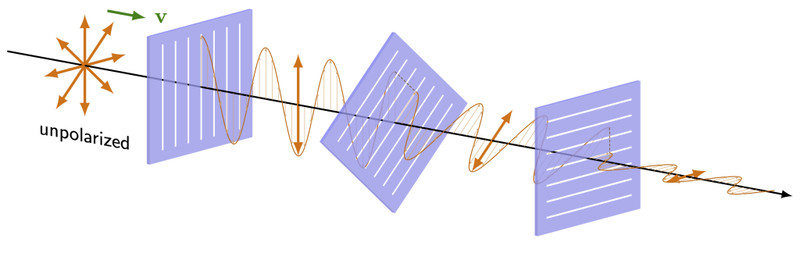
Unpolarized light passing through three polarizers
After the first polarizer, the light is polarized and its intensity is cut in half. Each additional polarizer reduces the intensity according to , where is the angle between the light’s polarization direction and the filter’s axis.
If you start with 80 W/m² of unpolarized light:
- After first polarizer → 40 W/m²
- After second at 60° → W/m²
On multiple-choice, they love stacking polarizers and seeing if you remember to halve first before applying .
