Topic 15.3 Notes – Emission and Absorption Spectra
1. What Atomic Energy Levels Are
In this course, an atom is a two-particle system: a nucleus and one electron interacting electrically. That interaction gives the system specific allowed energy states.
These energies are quantized, meaning:
- The electron cannot have just any energy.
- Only certain discrete values are allowed.
Important ideas:
- The reference point is when the electron is infinitely far from the nucleus.
- Bound electrons have negative energy.
- More negative energy → electron is more tightly bound.
- Less negative energy → electron is less tightly bound.
Ground and Excited States
Ground state
Lowest possible energy. Electron is most tightly bound.Excited state
Any higher allowed energy level. Electron is less tightly bound.
We represent these with energy level diagrams. The diagram below shows the allowed energy levels for hydrogen along with the corresponding Bohr orbits.
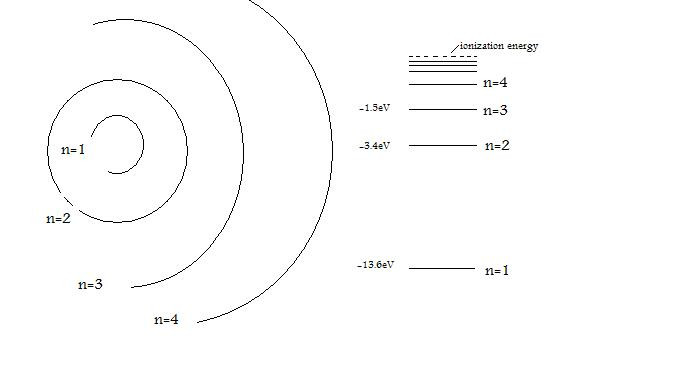
Hydrogen energy levels and Bohr orbits
- Each horizontal line represents one allowed energy value (for example, −13.6 eV for ).
- Levels closer to 0 eV are less tightly bound.
Only single-electron atoms like hydrogen are tested in AP Physics 2.
2. How Atoms Absorb and Emit Photons
Energy moves between atoms and light through photons.
The key rule:
The photon’s energy must match the exact energy gap between two allowed states.
Absorption
If an electron is in a lower energy state and a photon with exactly the right energy hits it:
- The atom absorbs the photon.
- The electron jumps to a higher energy level.
- The electron-nucleus interaction energy increases (becomes less negative).
If the photon energy does not match a gap, nothing happens. This “all or nothing” idea shows up a lot on conceptual questions.
Emission
If an electron is in an excited state:
- It can spontaneously drop to a lower energy.
- A photon is emitted.
- The photon carries away exactly the energy difference.
When the electron moves closer to the nucleus, the interaction energy becomes more negative, and that lost energy leaves as electromagnetic radiation.
Energy, Frequency, and Wavelength
Photon energy connects to frequency and wavelength:
- Larger → larger → shorter
- Smaller → smaller → longer
On tests, you’ll often:
- Find from an energy diagram.
- Set .
- Solve for or .
3. Emission Spectra vs. Absorption Spectra
Each element has its own set of allowed energy levels. That means each element has a unique set of photon frequencies.
This creates a spectral “fingerprint.”
Emission Spectrum
Produced when excited atoms emit light.
- Bright lines on a dark background.
- Each line corresponds to one transition.
- Used to identify elements in stars, gas tubes, etc.
In the examples below, each element shows a different pattern of colored lines. That pattern is the fingerprint.
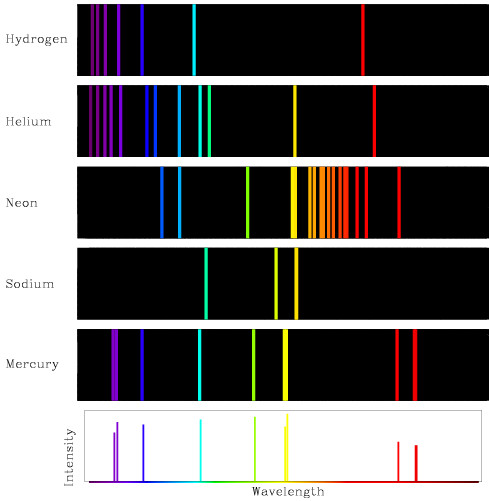
Emission spectra of several elements
Absorption Spectrum
Produced when continuous light passes through a cooler gas.
- Atoms absorb specific frequencies.
- Dark lines appear in an otherwise continuous rainbow.
Compare the absorption band to the emission lines. The dark lines occur at the same wavelengths as the bright emission lines for that element.
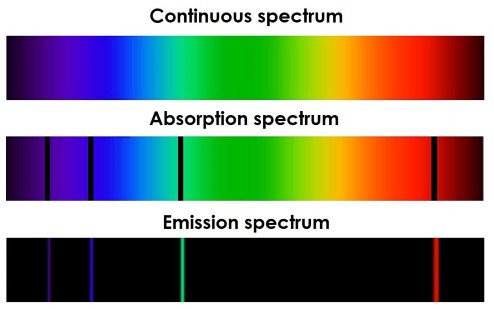
Continuous, absorption, and emission spectra
Quick Comparison
| Feature | Emission | Absorption |
|---|---|---|
| Electron motion | High → Low | Low → High |
| Photon | Released | Absorbed |
| Appearance | Bright lines | Dark lines |
| Use | Identify light source | Identify absorbing material |
The pattern of lines is what matters, not brightness.
4. Binding Energy and Ionization
Binding energy is the energy required to remove the electron completely from the atom.
Ionization happens when the electron reaches .
- Ground state → largest binding energy.
- Excited state → smaller binding energy.
Three common cases:
Electron can move to a higher bound state only if the photon energy exactly matches the gap between two allowed levels. Otherwise, the photon is not absorbed at all.
Electron just barely escapes.
Ionization occurs, and extra energy becomes kinetic energy of the electron.
Stronger nuclear charge means stronger attraction and larger binding energy.
On FRQs, be ready to explain ionization in words. Say that the photon increases the electron-nucleus interaction energy to zero, freeing the electron.
