Topic 11.7 Notes – Kirchhoff’s Junction Rule
Topic 11.7 covers Kirchhoff’s Junction Rule, which comes directly from conservation of electric charge.
1. What Kirchhoff’s Junction Rule Says
Everything here starts with conservation of electric charge. Charge cannot be created or destroyed. In a steady-state circuit, charge does not pile up anywhere.
A junction (node) is a point where two or more conductors meet.
Here’s the rule:
This means the algebraic sum of currents at a junction is zero.
Another way to say it:
Current is . So the rule is really saying:
- The amount of charge entering per second
- equals the amount of charge leaving per second
If more charge entered than left, charge would build up at the junction. That does not happen in steady DC circuits.
Visualizing a Junction
Focus on node b in the circuit below. Three branches meet there, making it a junction.
In this diagram, flows into node b, while and flow out.
Using Kirchhoff’s Junction Rule at that node:
The signs come from your direction choices.
2. Current and Sign Conventions at a Junction
The physics is simple. The algebra is where students lose points.
You must choose a sign convention and stick with it.
Common choice:
- Currents entering → positive
- Currents leaving → negative
Then write:
Example (with numbers):
Suppose:
- 5 A enters
- 2 A leaves
- One current is unknown
Using entering positive:
Since we subtracted , that means it was assumed leaving. The positive result confirms it really is leaving.
If you ever get a negative answer, it just means the current flows opposite your assumption. That’s not wrong. On AP free-response questions, they expect you to interpret that correctly.
3. How to Apply the Junction Rule
When you see a circuit problem, the process is mechanical:
- Locate a junction with three or more branches.
- Label all currents.
- Use given directions.
- If unknown, assume one.
- Choose a sign convention.
- Write one equation using .
- Solve algebraically.
- Interpret the sign of your result.
That’s it. No new physics beyond conservation of charge.
On tests, they sometimes hide the junction inside a messy diagram. Slow down and isolate just the node.
4. Where the Junction Rule Shows Up in Circuits
Parallel Circuits
In a parallel circuit, one current leaves the battery and then splits at a junction into multiple branches.
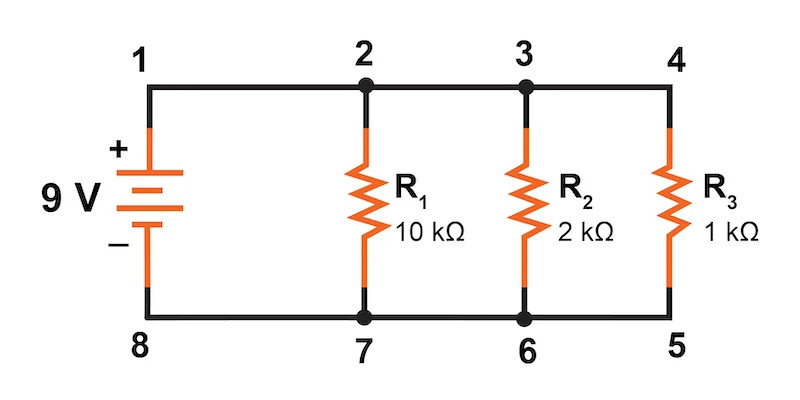
Parallel circuit with three resistors across a 9 V battery
In this example, the total current from the 9 V battery reaches the top junction and divides into three branch currents through , , and . At that junction, the sum of the branch currents equals the current supplied by the battery.
Key idea:
- Current divides among branches.
- Lower resistance → larger current (from ).
Students often think current “gets used up.” It doesn’t. Energy changes across elements. Charge flow does not disappear.
Multi-Loop Circuits
In more complex circuits:
- The Junction Rule comes from conservation of charge.
- The Loop Rule comes from conservation of energy.
You usually:
- Write one equation from a junction.
- Write one or more loop equations.
- Solve the system.
Many AP circuit problems require both rules together.
Applies to Any Element
The Junction Rule works for:
- Resistors
- Capacitors (in steady state)
- Inductors
- Batteries
It is not limited to resistors. It applies anywhere charge flows.
