Topic 14.5 Notes – The Doppler Effect
1. What the Doppler Effect Is
The Doppler effect is the change in observed frequency caused by relative motion between a wave source and an observer.
Three key terms:
- Rest frequency : The frequency emitted by the source when there is no relative motion.
- Observed frequency : The frequency the observer actually detects.
- Doppler shift: The difference between and .
What matters is relative velocity. It does not matter who is “really” moving.
- If source and observer move together at the same velocity → no relative motion →
- If there is relative motion →
This shows up constantly in conceptual multiple-choice questions where they describe both source and observer moving. Always compare their motion to each other.
2. How Relative Motion Changes Frequency
Think about frequency as how many wave crests reach the observer per second.
Motion changes the spacing between crests, which changes how many arrive each second.
Same Velocity → No Shift
If the source and observer move at the same velocity in the same direction:
- No relative motion
- Wave spacing at the observer is unchanged
Even if they’re both moving fast, there is no Doppler shift if their relative velocity is zero.
Source Moving Toward the Observer
When the source moves toward the observer:
- Wave crests bunch together in front of the source
- Wavelength in front becomes shorter
- More crests hit the observer each second
- Observed frequency increases
This is sometimes called a positive Doppler shift.
The faster the approach, the greater the increase in frequency.
Source Moving Away from the Observer
When the source moves away:
- Wave crests spread out behind it
- Wavelength becomes longer
- Fewer crests arrive each second
- Observed frequency decreases
The faster the recession, the larger the decrease.
3. What Controls the Size of the Doppler Shift
Two things determine what you observe:
1. Direction of relative motion
- Toward → frequency increases
- Away → frequency decreases
- No relative motion → no shift
2. Magnitude of relative velocity
- Greater relative speed → larger difference between and
- Smaller relative speed → smaller shift
- Zero relative speed → zero shift
AP questions often compare scenarios. If one car approaches at 30 m/s and another at 10 m/s, the 30 m/s case produces the larger shift. You are comparing how different the observed frequency is from the rest frequency.
4. What Is Physically Happening to the Waves
Here’s what it looks like when a source moves. Focus on the middle and right panels, where the source is moving relative to the observer:
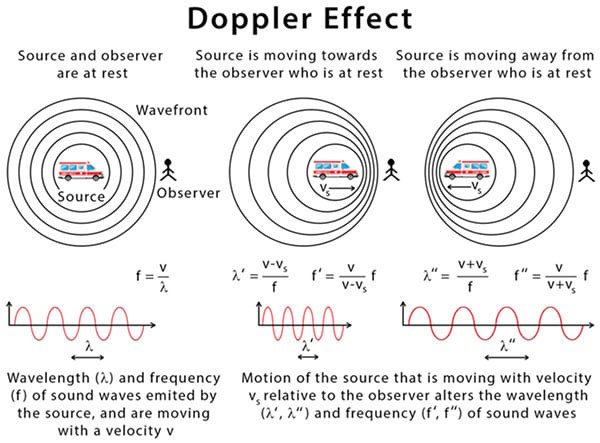
The source emits waves at equal time intervals. But because it moves between emissions:
- In front of the source → crests are closer together
- Behind the source → crests are farther apart
The wave speed in the medium stays the same. What changes is the wavelength, and since wave speed , a change in wavelength means a change in frequency.
This explains the classic pitch change when a vehicle passes you:
- Approaching → higher pitch
- Right as it passes → sudden drop
- Moving away → lower pitch
5. Applications You Should Recognize
Sound
Any moving sound source shows Doppler shift. You hear pitch changes because pitch is directly related to frequency.
Light and Astronomy
Light also experiences Doppler shifts.
- Blueshift → shorter wavelength, higher frequency
→ Object moving toward Earth - Redshift → longer wavelength, lower frequency
→ Object moving away from Earth
The spectrum below shows how the same set of spectral lines shifts toward the red end when a source moves away and toward the blue end when it moves closer.

Redshift and blueshift of spectral lines
Greater redshift means greater recessional speed. This is one of the key observations that supports the expanding universe.
Radar and Medical Uses
- Police radar measures speed from frequency shifts of reflected waves.
- Weather radar tracks storm motion.
- Doppler ultrasound measures blood flow direction and speed.
On FRQs, you may be asked to describe what happens to frequency and explain why. Your explanation should mention:
- Relative motion
- Wavefront compression or stretching
- Change in number of crests per second detected
