Topic 10.4 Notes – Electric Potential Energy
What Electric Potential Energy Is
Electric potential energy is the energy stored in a system of charges due to their separation.
Two key ideas:
- It equals the work an external force must do to bring charges from infinitely far apart (where ) to their current positions.
- It belongs to the system of charges, not to just one charge by itself.
The zero reference point is defined at infinity. When charges are infinitely separated, we say .
This mirrors gravitational potential energy:
- Both come from conservative forces.
- Energy depends only on positions, not the path taken.
- Total mechanical energy is conserved (if isolated).
The Sign of
The sign tells you about attraction vs. repulsion.
- Like charges (+/+ or −/−)
- They repel.
- You must push them together.
- Unlike charges (+/−)
- They attract.
- They naturally move together and release energy.
If a system has negative , it’s a bound system. You must add energy to pull the charges apart to infinity.
Electric Potential Energy Between Two Point Charges
For two point charges, the equation you need is
- in coulombs
- in meters
- in joules
If you graph this equation for opposite charges, you get a curve like this:
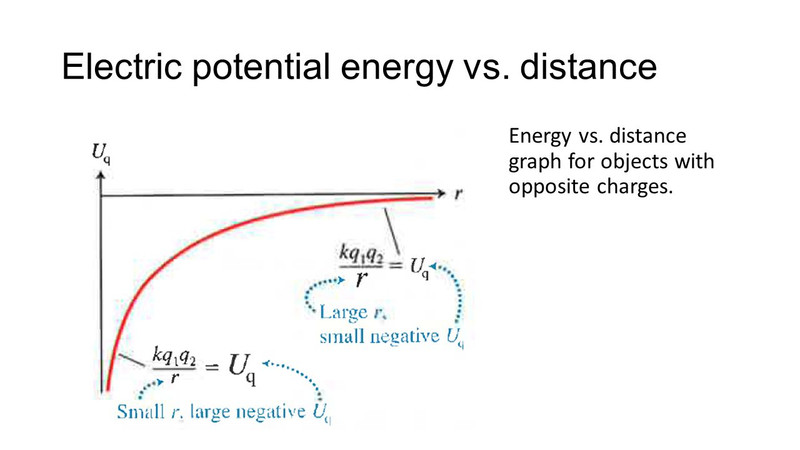
Electric potential energy vs. separation for opposite charges
How to Think About the Variables
- Larger charge magnitudes → larger .
- Larger distance → smaller .
- The product determines the sign.
On the graph, notice that for an attractive pair the potential energy is negative and approaches 0 as becomes very large. As the charges get closer together, becomes more negative.
Quick reasoning example:
Suppose and are both positive. If you cut the distance in half, since , the potential energy doubles. On a multiple-choice question, they often test this proportional reasoning instead of full calculation.
Work and Separation
If the current potential energy is , then:
- Work required to separate the charges to infinity
If is negative (attractive pair), separating them requires positive work.
That sign logic shows up constantly on FRQs.
Total Electric Potential Energy of Multiple Charges
For 3 or 4 point charges, the total potential energy is the sum of all unique pairs.
You calculate each pair separately and add them algebraically.
Number of Pairs
- 2 charges → 1 pair
- 3 charges → 3 pairs
- 4 charges → 6 pairs
For three charges :
You never double-count.
How This Looks Physically
For three charges arranged in space, each pair has its own separation distance.
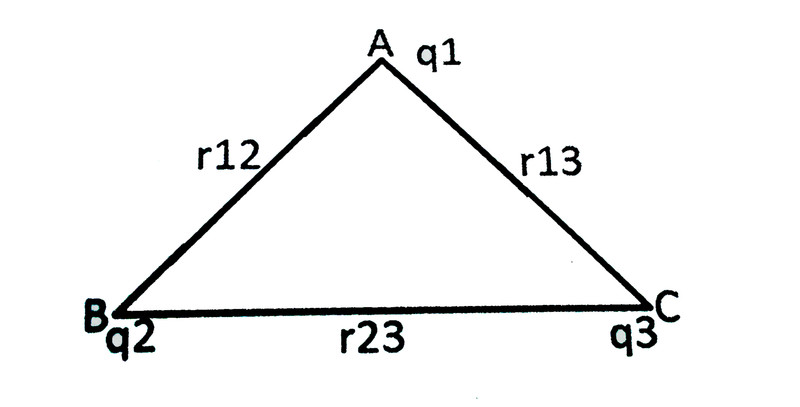
Three point charges and their pairwise separations
Each side of the triangle corresponds to one interaction term in the total energy: , , and .
On tests, the hardest part is usually:
- Finding the correct distances (geometry).
- Keeping track of signs when adding terms.
Reminder: AP Physics 2 limits you to four or fewer point charges. No continuous charge distributions.
Conservation of Energy in Electric Systems
Because electric forces are conservative:
If opposite charges move closer:
- becomes more negative.
- increases.
If like charges are pushed closer:
- increases.
- External work must add energy.
The connection between force and energy is:
That negative sign is huge. When the electric force does positive work, potential energy decreases.
On FRQs, you’re often asked to explain this in words. A strong answer says something like:
“As the charges move closer, the electric force does positive work on the system, so electric potential energy decreases and kinetic energy increases to conserve total energy.”
