Topic 14.9 Notes – Thin-Film Interference
1. What Thin-Film Interference Is
When light hits a boundary between two media, three things can happen:
- Transmitted light enters the second medium (it refracts).
- Reflected light bounces off the boundary.
- Absorbed light is converted to other energy (often ignored in ideal AP problems).
In a thin film, light reflects from two surfaces. In the diagram below, light in medium strikes a thin layer of thickness , with a third medium beneath it.
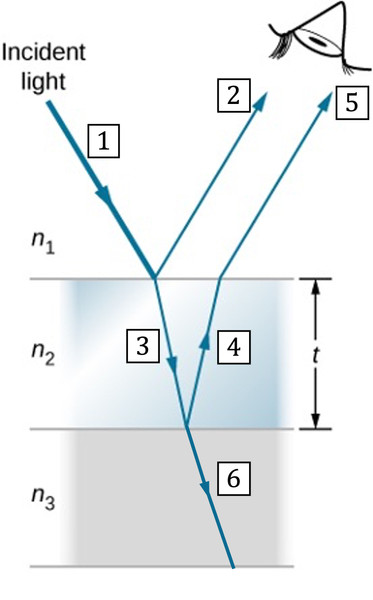
You get:
- The ray reflected from the top surface (the boundary between and ).
- The ray transmitted into the film, reflected from the bottom surface (the boundary between and ), then exiting back upward.
These two reflected rays overlap and interfere. The result is one combined reflected wave that may be bright (constructive) or dim (destructive).
Thin-film interference depends on:
- Film thickness
- Wavelength
- Indices of refraction
- Phase shifts at reflections
- (On the AP exam, assume normal incidence only.)
2. Phase Changes at Boundaries
The most important idea in this topic is the phase shift on reflection.
Reflection and Phase Shift
When light reflects:
- From lower to higher
→ 180° phase shift (half a wavelength) - From higher to lower
→ No phase shift
So if light goes from air into glass , the reflected ray flips by 180°.
If it reflects from glass back into air, no phase shift.
Refraction and Phase
When light refracts into a new medium:
- No phase change
- Speed changes
- Wavelength changes
- Frequency stays the same
Wavelength inside the film is
You must use the wavelength in the film when writing interference conditions.
Students often lose points by forgetting this conversion.
3. Conditions for Constructive and Destructive Interference
For normal incidence, the second ray travels down and back up through the film.
So the path difference is:
Interference depends on:
- The path difference
- The wavelength in the film
- Whether there are 0, 1, or 2 phase shifts from reflection
There are two main cases.
Case A One 180° Phase Shift
This happens when only one reflection flips phase.
Example: air → film → air where film has higher than air.
Here the two reflected waves already differ by 180°.
- Constructive (bright reflection):
- Destructive (dark reflection):
Case B Zero or Two 180° Phase Shifts
Here there is no net phase difference from reflection.
- Constructive:
- Destructive:
Where
On tests, the hardest part is deciding which case you’re in. Always check the direction of reflection and compare indices.
4. What Thin-Film Interference Explains and Applications
Soap Bubbles and Oil Films
The colors come from varying thickness across the surface.
At one spot:
- Blue might satisfy constructive interference.
At another:
- Red might.
As thickness changes, the wavelength that satisfies the condition changes.
That’s why you see shifting rainbow patterns.
On free-response questions, you may need to explain this in words: different points have different , so different wavelengths constructively interfere.
Antireflection Coatings
Goal: eliminate reflected light using destructive interference.
Conditions:
- Typically gives two 180° phase shifts (Case B)
For minimum thickness:
This is a quarter-wavelength coating.
Why it works:
- Reflections have equal phase shifts.
- The extra travel creates a half-wavelength path difference.
- Reflected waves cancel.
- More light transmits through the lens.
Used in:
- Glasses
- Camera lenses
- Solar panels
