Topic 11.3 Notes – Resistance, Resistivity, and Ohm’s Law
1. What Resistance Is
Resistance (R) tells you how much an object opposes the flow of electric charge.
- Measured in ohms (Ω)
- Larger → smaller current for the same potential difference
- It is a property of the object, not just the material
Quick grounding. Current is the flow of charge caused by a potential difference. As electrons move through a material, they collide with vibrating atoms and imperfections. Those collisions slow them down. That slowing effect is resistance.
Two big factors determine resistance:
- The material
- The object’s geometry (its size and shape)
This is where resistivity comes in.
2. Resistivity and the Geometry of a Conductor
For a uniform wire or cylindrical resistor, resistance is
- = resistivity (Ω·m)
- = length
- = cross-sectional area
What Resistivity Means
Resistivity (ρ) is an intrinsic property of a material.
- It depends on the material’s atomic structure
- It tells you how strongly the material itself opposes charge flow
- Copper → very low
- Nichrome → much higher
Resistivity does not depend on length or area. If you cut a copper wire in half, its resistance changes, but its resistivity does not.
How Geometry Affects Resistance
From :
- Double the length → double the resistance
- Double the cross-sectional area → half the resistance
Compare these three wires made of the same material:
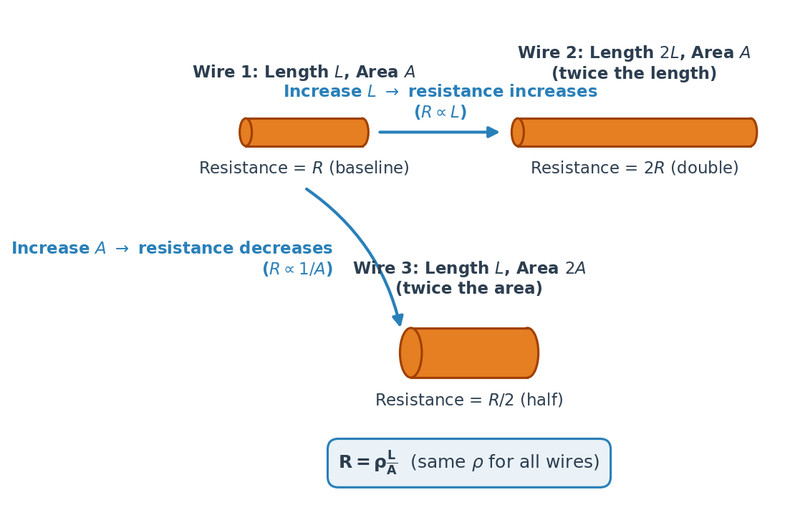
Resistance vs. length and cross-sectional area
The top pair shows what happens when you double the length. The bottom wire shows what happens when you double the area.
Longer wire means electrons have more collisions. Thicker wire gives them more “lanes” to move through.
Temperature and Resistivity
For most conductors:
- As temperature increases, resistivity increases
- Hotter atoms vibrate more → more collisions → harder for electrons to move
This temperature dependence is what makes many real materials non-ohmic over large temperature ranges. An ohmic material, by contrast, maintains constant resistance under the conditions you're testing it.
In a circuit with constant voltage:
- If increases, then decreases.
On conceptual questions, they love asking what happens to current when a wire heats up. Think collisions.
3. Ohm’s Law and Ohmic Materials
Ohm’s Law
Equivalent forms:
This applies to a single circuit element.
If voltage increases and resistance stays constant, current increases proportionally.
Ohmic vs Non-Ohmic Materials
Ohm’s law only works cleanly when resistance is constant.
| Ohmic Materials | Non-Ohmic Materials |
|---|---|
| Obey for all currents | Do not have constant R |
| Resistance stays constant (and resistivity is constant with temperature) | Resistance changes with V, I, or temperature |
| I vs V graph is a straight line through the origin | I vs V graph is curved |
| Slope of I vs V graph = | Slope changes |
Here’s what that looks like on an I-V graph (current on the vertical axis, voltage on the horizontal axis):
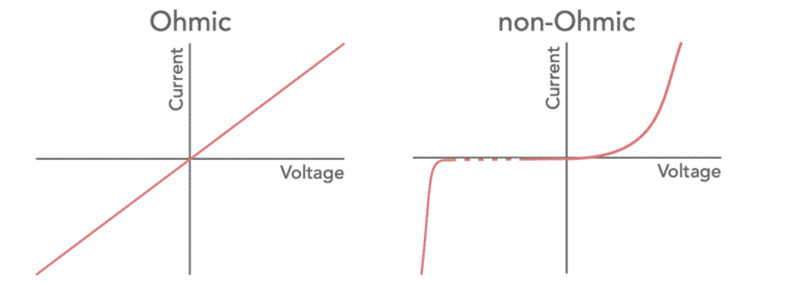
Ohmic vs non-ohmic I-V graphs
Be careful with graphs:
- If graph is I vs V, slope =
- If graph is V vs I, slope =
That slope-reading detail shows up constantly.
4. Electrical Energy and Resistive Heating
When current flows through a resistor, electrical energy turns into thermal energy. This is Joule heating.
Power is the rate of energy conversion:
Use whichever matches what you’re given.
Key relationships:
- Larger current → more heating
- At fixed current, larger R → more heating
- Heating can raise temperature → increase → increase R → decrease I (if V is fixed)
This feedback idea sometimes appears in explanation questions. You may need to write something like: “As the resistor heats, its resistivity increases, which increases resistance and reduces the current.”
