Topic 9.4 Notes – The First Law of Thermodynamics
1. What Internal Energy Is
Internal energy is the total microscopic energy of a system.
It includes:
- Kinetic energy of particles (random motion of atoms or molecules)
- Potential energy from interactions between those particles (how they’re arranged and pulling on each other)
This is energy inside the system. It is not the kinetic energy of the object’s center of mass.
You can heat a sealed metal box sitting still on a table. Its center of mass doesn’t move, but its internal energy increases because the atoms jiggle faster. That’s the distinction the AP likes you to articulate in words.
Ideal Gas Model
An ideal gas has two key features:
- Particles do not interact with each other (no intermolecular forces)
- Internal structure of atoms is ignored
So an ideal gas has no internal potential energy.
For a monatomic ideal gas, internal energy is purely kinetic:
That means:
- Internal energy depends only on temperature
- If temperature doesn’t change, doesn’t change
For changes:
This shows up constantly. If you see “monatomic ideal gas,” your brain should immediately connect to .
2. The First Law of Thermodynamics
This is conservation of energy for thermal systems.
For a closed system (energy can move in or out, but no matter enters or leaves):
- = heat added to the system
- = work done on the system
Sign conventions matter a lot:
- Heat added →
- Heat removed →
- Compression (work done on gas) →
- Expansion (gas pushes outward) →
Students lose easy points by flipping signs. If the gas expands and pushes a piston out, the surroundings did not do work on it. So is negative.
For an isolated system, no energy enters or leaves. Total energy stays constant.
3. Work and PV Diagrams
When a gas changes volume, work is involved.
If the external pressure is constant:
More generally:
- Expansion → →
- Compression → →
PV Diagrams
Each point on a - graph represents a thermodynamic state.
A curve between two points represents a process connecting those states.
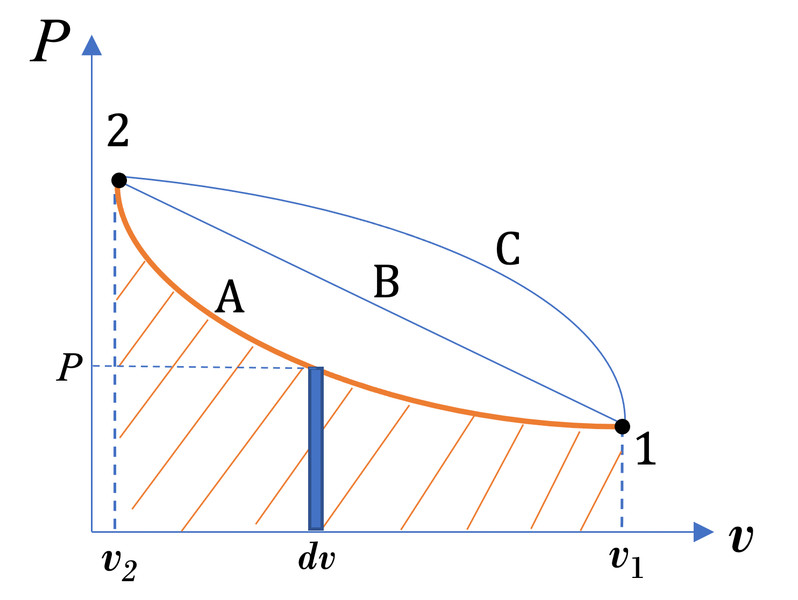
Work as area under a PV curve
The area under the curve between the initial and final volumes equals the magnitude of the work.
- Expansion → area represents work done by the gas
- Compression → same area idea, but work done on the gas
The diagram also shows different possible paths between the same initial and final states. Different paths give different areas, so the work depends on the path taken.
Isotherms are constant-temperature curves. For an ideal gas, , so higher-temperature isotherms lie farther from the origin.
On FRQs, if they ask you to compare work for two different paths between the same states, you’re comparing areas.
4. Special Thermodynamic Processes
These are the four you must recognize instantly.
| Process | What stays constant | Key result (ideal monatomic gas) |
|---|---|---|
| Isovolumetric | constant | , so |
| Isothermal | constant | , so |
| Isobaric | constant | , heat changes both and does work |
| Adiabatic |
What physically happens
- Isovolumetric: rigid container. All heat changes temperature.
- Isothermal: temperature fixed. Any heat added goes into doing work.
- Isobaric: piston moves at constant pressure.
- Adiabatic: insulated system. Compression raises temperature. Expansion lowers it.
A classic conceptual question: If you compress a gas quickly in an insulated cylinder, temperature increases. Why? Because work is done on the gas and , so , and for an ideal gas that means temperature rises.
That reasoning in words is exactly what earns full credit.
