Topic 9.5 Notes – Specific Heat and Thermal Conductivity
Specific heat and temperature change
When you add or remove thermal energy from an object and its temperature changes (no phase change), the relationship is:
- = thermal energy transferred (J)
- = mass (kg)
- = specific heat (J/(kg}\cdot\text{K) or J/kg·°C)
- = change in temperature
What specific heat actually means
Specific heat is the energy required to raise the temperature of 1 kg of a substance by 1 degree.
- It is an intrinsic property. It depends on the material’s atomic structure and bonding, not on how much you have.
- On the AP exam, assume is constant over the temperature range.
High means temperature changes slowly when energy is added.
Low means temperature changes quickly.
Water has a high specific heat. Many metals have much lower values. That’s why a metal pan heats up quickly but water takes longer.
Using in problems
Keep track of signs:
- Heating → ,
- Cooling → ,
If multiple objects are in thermal contact and isolated from the environment:
Energy lost by one object equals energy gained by the other.
Example idea:
A 0.20 kg copper block () cools from 80°C to 30°C.
The negative sign tells you energy leaves the block.
On FRQs, they often want a sentence like:
“Because copper has a relatively low specific heat, a small amount of energy loss produces a relatively large decrease in temperature.”
That’s the kind of reasoning statement that earns points.
Thermal conductivity and conduction rate
Now shift from how much energy changes temperature to how fast energy flows.
When there is a temperature difference across a material, energy transfers by conduction. The rate is:
- = rate of heat transfer (W = J/s)
- = thermal conductivity (W/m·K)
- = cross-sectional area (m²)
- = temperature difference
- = thickness of the material
What thermal conductivity means
Thermal conductivity is also an intrinsic property.
- Large → energy moves easily (metals, free electrons help transfer energy).
- Small → good insulator (foam, wood, fiberglass).
It depends on how atoms interact and, in metals, how freely electrons move.
What controls the rate of conduction
From
You can reason directly:
- Larger → larger rate
- Larger area → larger rate
- Larger temperature difference → larger rate
- Larger thickness → smaller rate
Here’s the physical picture. The slab below shows heat flowing from the hot side to the cold side, with the temperature decreasing across the material:
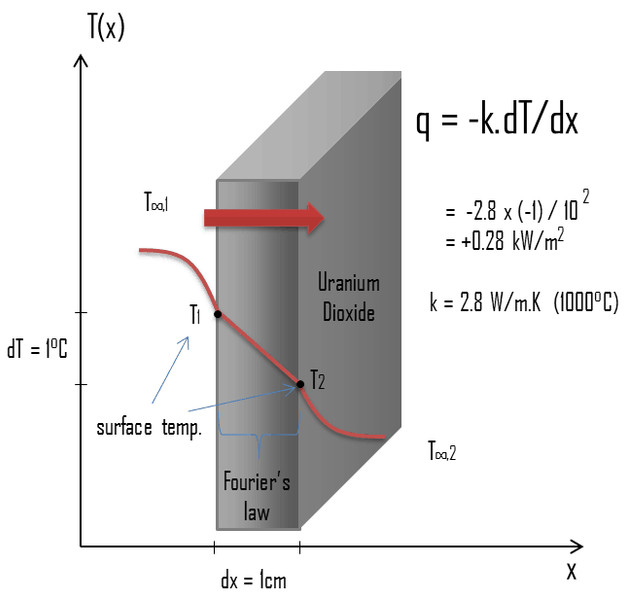
Heat conduction through a solid slab
- Bigger area means more particles interacting across the boundary.
- Larger means a steeper temperature gradient, so energy flows faster.
- Thicker material means energy has to travel farther.
Common quiz move:
“If the thickness doubles, what happens to the rate?”
Since is in the denominator, the rate is cut in half.
Connecting the two ideas
These equations answer different questions:
| Situation | Use This | Tells You |
|---|---|---|
| Temperature change of an object | Total energy involved (J) | |
| Energy flowing through a material | Rate of energy transfer (W) |
In multi-step problems, you might:
- Use the conduction equation to find power.
- Multiply by time to get total .
- Plug that into to find the temperature change.
Always check units. Watts are joules per second. If you’re asked for total energy, don’t stop at watts.
