Topic 13.1 Notes – Reflection
1. Light as a Ray
A light ray is a straight line that shows the direction light travels. It points in the direction of energy flow and is always perpendicular to the wavefront of the light wave.
That wave language matters. Even though we’re drawing straight lines, light is still a wave. The ray is just a simplified model.
Here’s how to think about it:
- A wavefront is a surface of equal phase (like the crests of a water wave).
- The ray sticks straight out from that surface at a right angle.
- The arrow on the ray shows the direction the light energy moves.
The left side of the diagram shows curved wavefronts spreading out from a point source, with rays drawn perpendicular to each wavefront. The right side shows plane wavefronts with parallel rays, which is how we model light far from the source.
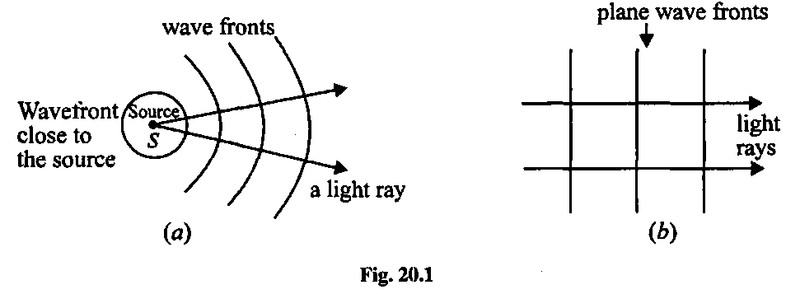
Wavefronts and perpendicular light rays
When the ray model works
We use rays in geometric optics, which applies when:
- The wavelength of light is much smaller than the objects it interacts with.
- We care about mirrors, flat surfaces, lenses, and image location.
- We are not analyzing interference or diffraction.
Rays cannot explain:
- Interference patterns
- Diffraction spreading
Those require full wave reasoning, which comes in Unit 14.
Laser as an example
A laser produces a coherent, monochromatic, highly directional beam. In geometric optics problems, you treat that beam as a single straight ray. Later you’ll care about its wave properties, but here it’s just a clean, straight path.
2. Ray Diagrams
A ray diagram shows the path of light before and after it interacts with a surface.
You always include:
- The incident ray (incoming light)
- The point of incidence
- The normal line (perpendicular to the surface at that point)
- The reflected ray
- Arrows to show direction
And the most common mistake:
Angles are measured from the normal, not from the surface.
Here’s what that setup looks like for a flat mirror:
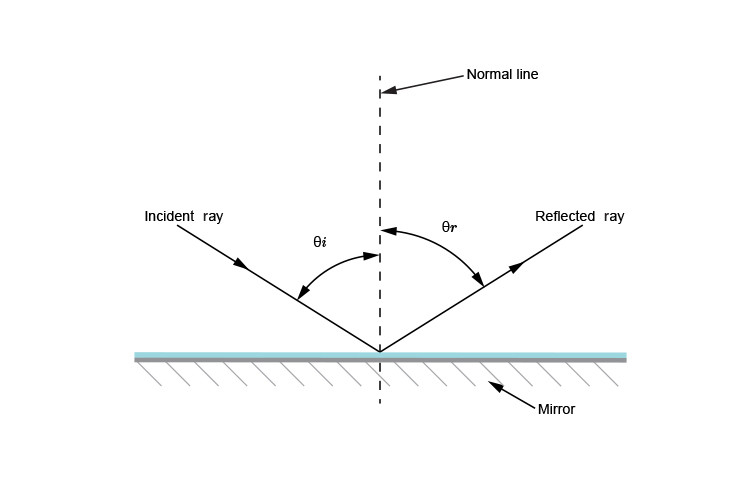
Ray diagram for reflection from a plane mirror
The angles and are both measured between each ray and the dashed normal line, not along the surface of the mirror.
On quizzes, teachers love giving you an angle measured from the surface. If a ray makes 25° with the surface, the angle from the normal is:
That conversion shows up a lot.
3. The Law of Reflection
When light hits a surface, some of it can be reflected.
The law of reflection says:
- : angle between incident ray and normal
- : angle between reflected ray and normal
Both angles are measured from the normal line.
Three important geometric facts:
- The incident ray, reflected ray, and normal all lie in the same plane.
- If , the ray reflects straight back.
- The angle between incident and reflected rays is .
Quick example:
If , then:
- Angle between rays =
On AP-style free response, you may be asked to justify this in words. A clean statement is:
“Because the angle of incidence equals the angle of reflection, measured from the normal, the reflected ray leaves the surface symmetrically relative to the normal.”
4. Types of Reflection
Both types obey . The difference is what happens to the surface normal across the surface.
Specular Reflection
Occurs on smooth surfaces.
- Surface normal is nearly the same everywhere.
- Parallel incident rays reflect as parallel rays.
- Clear image formation.
- Examples: mirrors, polished metal, calm water.
Because the reflected rays stay organized, your eye can trace them back to a single apparent location. That’s how images form.
Diffuse Reflection
Occurs on rough surfaces.
- Surface normal changes from point to point.
- Each tiny region still follows .
- Reflected rays scatter in many directions.
- No clear image.
Examples:
- Paper
- Fabric
- Matte walls
- Rough wood
Important: diffuse reflection does not break the law of reflection. The scattering happens because the normal direction varies across the surface.
This is why you can see a matte wall from many angles. Light reflects in many directions, so some of it reaches your eyes no matter where you stand.
