Topic 14.4 Notes – Electromagnetic Waves
1. What Electromagnetic Waves Are
An electromagnetic (EM) wave is a wave made of oscillating electric fields (E) and magnetic fields (B).
- The fields change with time.
- They are created by accelerating charges.
- They carry energy through space.
Unlike sound waves or water waves, EM waves do not need a medium. That’s why sunlight can travel through the vacuum of space to Earth. There are no particles in space carrying it along. The fields themselves carry the energy.
This difference from mechanical waves shows up all over conceptual questions. If the situation says “vacuum,” sound is out, but EM waves are fine.
Field Orientation and Transverse Nature
The geometry matters a lot.
Here is the standard picture of a plane electromagnetic wave traveling in the +x direction.
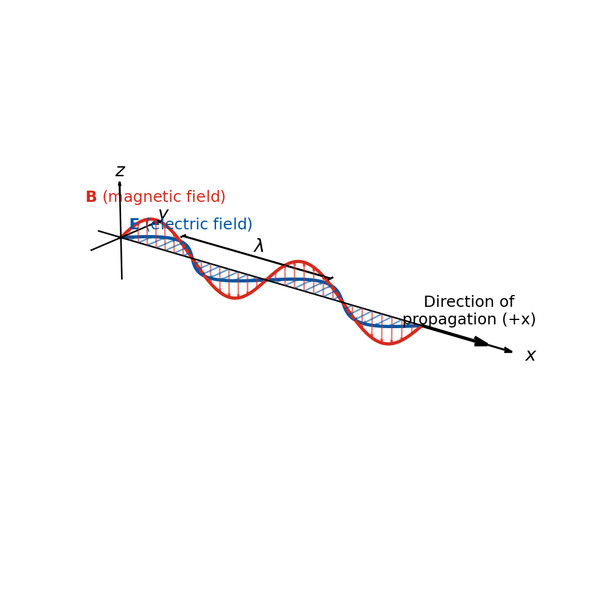
Electromagnetic wave with perpendicular E and B fields
From the diagram:
- The electric field and magnetic field are:
- Perpendicular to each other
- Perpendicular to the direction the wave travels
If the wave moves in the +x direction:
- could oscillate in the y direction
- would oscillate in the z direction
Because the oscillations are perpendicular to the direction of motion, EM waves are transverse waves.
When you’re asked to justify that in words, say something like:
“The electric and magnetic fields oscillate perpendicular to the direction of propagation, so the wave is transverse.”
That sentence earns points.
Plane Waves
In AP Physics 2, we usually model EM waves as plane waves.
A plane wave has flat wave fronts, meaning all points on a given plane are in the same phase.
The right-hand diagram below shows the simplified picture you should recognize on the exam: parallel, equally spaced wave fronts moving to the right.
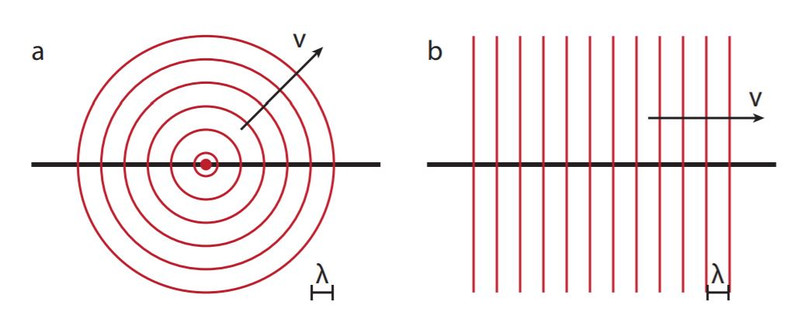
Plane wave fronts compared to circular wave fronts
You won’t be deriving anything about them. Just recognize that this is the standard simplified picture.
2. How Electromagnetic Waves Propagate and Their Key Relationship
The reason EM waves don’t need a medium is built into how they work.
- A changing electric field produces a magnetic field.
- A changing magnetic field produces an electric field.
These fields continuously regenerate each other as the wave moves forward. That’s the self-sustaining mechanism.
All EM waves in a vacuum move at the same speed:
That includes radio waves, visible light, X-rays, everything.
The wave relationship is:
Where:
- = speed of light in vacuum
- = wavelength
- = frequency
Since is constant in vacuum:
- Higher → shorter
- Lower → longer
If you’re given a frequency, you should immediately think
.
A common trap is mixing up which region has the longer wavelength. Always tie it back to .
3. The Electromagnetic Spectrum
EM waves are categorized by wavelength (or equivalently frequency).
In order of decreasing wavelength (longest → shortest):
- Radio
- Microwaves
- Infrared
- Visible
- Ultraviolet
- X-rays
- Gamma rays
In the diagram, notice how the waves become more tightly packed as you move from radio toward gamma. That visual shrinking of wavelength means frequency is increasing.
Across that list from radio → gamma:
- Wavelength decreases
- Frequency increases
- Energy increases
You do not need exact wavelength values. The exam will not ask you to define nanometer ranges. You just need the correct order.
If they ask which has more energy, always go toward the gamma ray side.
4. Visible Light Within the Spectrum
Visible light is a tiny band within the spectrum.
Within visible light, the order (longest → shortest wavelength) is:
- Red
- Orange
- Yellow
- Green
- Blue
- Violet

Visible light spectrum from red to violet
The diagram shows the continuous color gradient from red at the long-wavelength end to violet at the short-wavelength end.
So:
- Red → longest wavelength, lowest frequency (in visible)
- Violet → shortest wavelength, highest frequency (in visible)
Using :
- Blue light has a higher frequency than green.
- Red light has a lower frequency than yellow.
Also, be aware of wording. Sometimes “light” means only visible light. Sometimes it means all electromagnetic radiation. Use context.
