Topic 13.3 Notes – Refraction
1. What Refraction Is
Refraction is the change in direction of a light ray as it passes from one medium into another.
The reason is simple: the speed of light changes in different materials.
- In vacuum, light travels at
- In materials like air, water, or glass, light travels slower.
- The frequency stays the same at the boundary.
- The speed and wavelength change, and that change in speed causes bending.
If the speed didn’t change, the direction wouldn’t change.
Angles and the Normal
All angles are measured from the normal, not from the surface. In the diagram, notice the dashed vertical line at the boundary. That line is the normal.
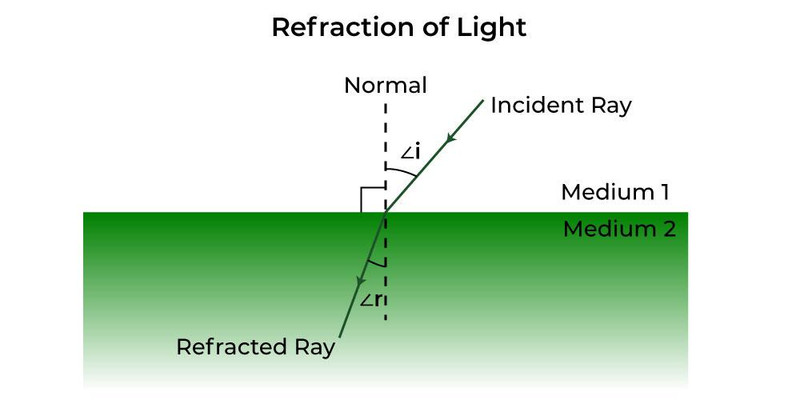
Refraction at a boundary with angles measured from the normal
Special case:
- If the ray travels along the normal (), it keeps going straight.
- No bending because there’s no sideways component to redirect.
On tests, students lose points for measuring from the surface instead of the normal. Always picture that perpendicular line first.
2. Index of Refraction
The index of refraction tells you how much a material slows light.
- = index of refraction (no units)
- = speed of light in vacuum
- = speed of light in the medium
Bigger means smaller . So light moves slower.
Typical values:
- Vacuum: 1.00
- Air: about 1.00
- Water: 1.33
- Glass: around 1.5
- Diamond: about 2.4
If you’re given speed, use . If you’re given , use .
Conceptually:
- Higher = optically denser = light slows more.
- A bigger difference between indices means stronger bending.
On conceptual questions, if they say “material A has a higher index than material B,” that automatically tells you light travels slower in A.
3. Snell’s Law
Snell’s law connects angles and indices when light crosses a boundary.
- , : first medium
- , : second medium
How the Ray Bends
| Situation | What Happens to Angle | Direction of Bending |
|---|---|---|
| Low n → High n (air → water) | Toward the normal | |
| High n → Low n (water → air) | Away from the normal | |
| No bending |
You can often predict the direction without calculating. That’s huge for multiple choice.
Using Snell’s Law
Suppose light goes from glass () into water () at .
Solve:
Since it’s going from higher to lower , the angle must increase. If your math gives a smaller angle, you made an error.
That physical check saves people all the time on FRQs.
4. Total Internal Reflection
Total internal reflection (TIR) happens when refraction can’t occur.
It only happens if:
- Light travels from higher to lower .
- The incident angle is large enough.
Critical Angle
At a certain angle, the refracted ray would be to the normal, skimming along the boundary.
- = current medium (must be larger)
- = second medium (must be smaller)
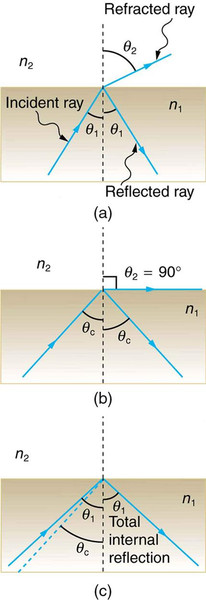
Refraction, critical angle, and total internal reflection
The three panels show what happens as the incident angle increases.
Behavior:
- If , some light refracts.
- If , refracted ray travels along surface.
- If , all light reflects back inside.
The reflected ray follows the law of reflection.
Applications:
- Fiber optic cables trap light using TIR.
- Diamonds sparkle because their high gives a small critical angle, so light keeps bouncing inside.
A common trap: TIR cannot happen when going from low to high . Ever.
