Topic 11.6 Notes – Kirchhoff’s Loop Rule
1. Energy Changes for Charges in a Circuit
Every time a charge moves through part of a circuit, its electric potential energy changes according to
Electric potential is energy per unit charge, so this equation is just bookkeeping for energy.
Here’s how that plays out in real circuits:
- Through a battery (from − to + terminal)
- The charge gains electric potential energy.
- Chemical energy inside the battery is converted to electric potential energy.
- Through a resistor (in the direction of current)
- The charge loses electric potential energy.
- That energy becomes thermal energy in the resistor.
Now the key idea: if a charge goes all the way around a loop and ends where it started, its net change in electric potential energy must be zero. It can’t come back with extra energy or missing energy.
That statement is the foundation of Kirchhoff’s loop rule.
2. Kirchhoff’s Loop Rule
Kirchhoff’s loop rule says:
The algebraic sum of all potential differences around any closed loop is zero.
Why? Because of conservation of energy. If a charge starts and ends at the same point, its total energy change must be zero. Any energy gained from batteries must equal energy lost in resistors or other elements.
In a simple series loop, this often becomes:
which rearranges to
That’s just energy balance written in voltage language.
On quizzes, they love giving you a loop with one unknown current. Your job is to translate each element into a voltage rise or drop and enforce energy conservation.
3. Applying the Loop Rule Step by Step
1. Choose a direction
Pick clockwise or counterclockwise. It truly does not matter. Just stay consistent.
2. Assign signs correctly
Battery (emf )
- Going from − to + terminal →
- Going from + to − terminal →
Resistor (using )
- Moving with the current → (voltage drop)
- Moving against the current →
The sign depends on both your chosen loop direction and the direction of current.
3. Write the equation
Suppose you have a 9 V battery and two resistors, 4 Ω and 5 Ω, in series.
Walking in the direction of current:
Notice what happened. The battery supplied 9 V. The resistors together dropped 9 V. Energy gained equals energy lost.
If you accidentally mess up a sign, you’ll often get a negative current. That doesn’t mean you failed. It means the real current flows opposite your assumed direction.
4. Electric Potential vs Position Graphs
Here’s what a potential vs position graph looks like for a single-loop circuit with one ideal battery and two resistors in series:
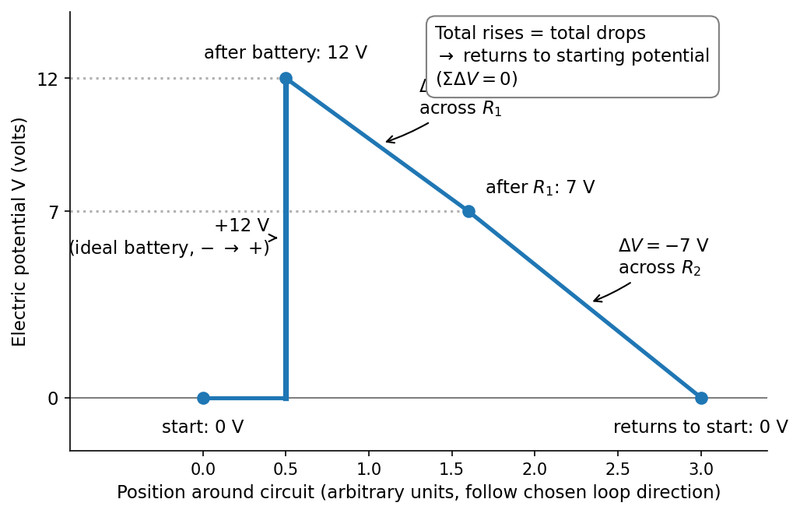
How to read this:
- Vertical jump → ideal battery (sudden voltage rise)
- Slanted downward line → resistor (steady drop in potential)
- Steeper slope → larger voltage drop (for the same current)
The most important feature is that after one full loop, the graph returns to the starting potential. If it didn’t, energy wouldn’t be conserved.
On tests, you might be asked to sketch or interpret one of these. Always check that total rises equal total drops.
5. What the Loop Rule Is Used For
You use Kirchhoff’s loop rule to:
- Find unknown currents in single-loop circuits
- Analyze multi-loop circuits (paired with the junction rule)
- Explain energy transformations in words
- Interpret potential graphs around a circuit
In written responses, phrases like “By conservation of energy, the sum of the potential differences around the loop is zero” earn you points because they tie the math to physics.
At its core, every loop equation you write is just an energy balance for a charge.
