Topic 15.1 Notes – Quantum Theory and Wave-Particle Duality
What quantum theory says about matter and light
By the early 1900s, experiments like atomic emission spectra, blackbody radiation, and the photoelectric effect didn’t match classical predictions. At atomic and subatomic scales, a new model was needed.
Quantum theory says:
- Matter and energy behave differently at very small scales.
- Fundamental particles can show both particle-like and wave-like behavior.
- Certain quantities, especially energy in bound systems, are quantized (only specific values allowed).
This is the core idea of wave-particle duality. What you observe depends on the experiment.
- In interference experiments → wave behavior.
- In energy-transfer experiments → particle behavior.
For macroscopic objects, classical physics works because quantum effects are too small to notice.
Light as photons
Light behaves like a wave (interference, diffraction), but it also behaves like a stream of particles called photons.
Photon properties
A photon is:
- Massless
- Electrically neutral
- Travels in straight lines unless interacting with matter
- Has energy proportional to frequency:
where
= frequency
Since :
- Higher frequency → higher energy → shorter wavelength
- UV photons have more energy than visible photons
- Radio photons have very low energy
Quick example: If ,
On tests, they often want you to connect frequency directly to photon energy without calculating wavelength first.
Speed of photons in different media
All photons travel at the same speed in vacuum:
In a material:
- = index of refraction
- Larger → smaller speed
Important:
- Frequency does not change when light enters a new medium.
- Wavelength changes because .
This change in speed causes refraction.
Matter as waves
Louis de Broglie proposed that particles also have wave properties.
The de Broglie wavelength
For nonrelativistic motion in AP Physics 2, .
Key ideas:
- Smaller momentum → larger wavelength
- Larger mass or speed → smaller wavelength
Example idea: An electron moving slowly can have a wavelength comparable to atomic spacing. A baseball’s wavelength is so tiny it’s undetectable.
Quantum effects matter when:
- The de Broglie wavelength is comparable to system size.
Double-slit evidence
When electrons pass through two slits, they form an interference pattern on a screen.
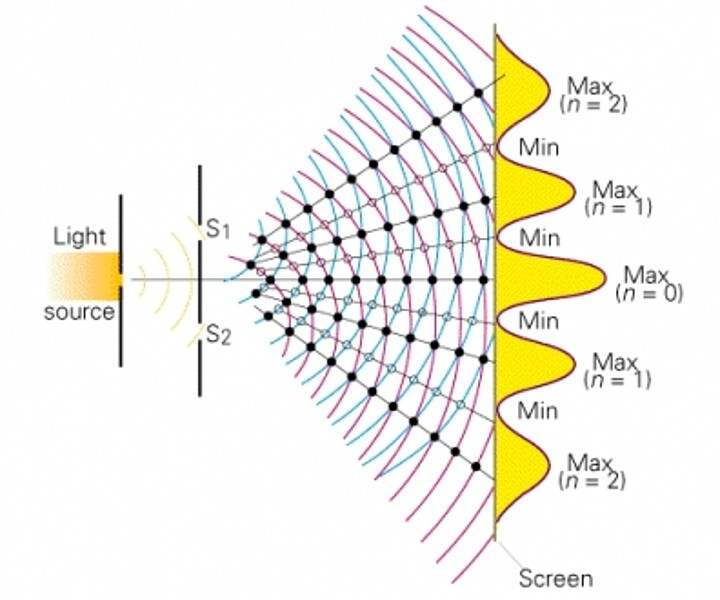
Double-slit interference pattern (maxima and minima)
The bright regions labeled “Max” are where waves from the two slits arrive in phase and interfere constructively. The dark regions labeled “Min” are where they arrive out of phase and interfere destructively.
Instead of two bands, which you would expect for simple particles, you see many alternating bright and dark fringes. Even firing electrons one at a time still builds this interference pattern over time.
That result forces us to accept wave-particle duality for matter.
Quantization in bound systems
When particles are bound (like electrons in atoms), energy is not continuous.
Electrons can only occupy specific energy levels.
If an electron transitions between levels:
Only photons with exactly that energy can be absorbed or emitted.
This leads directly to line spectra, like the absorption and emission patterns shown below for several elements.
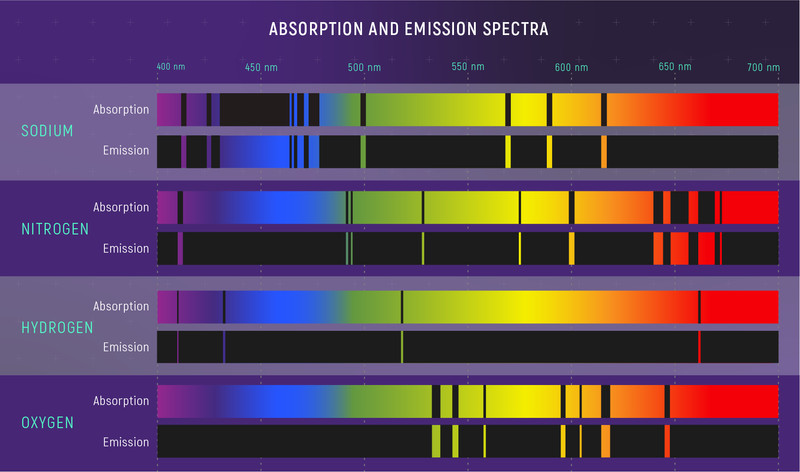
Absorption and emission line spectra for several elements
Each element has its own unique set of bright emission lines and dark absorption lines because its allowed energy levels are different.
If energy were continuous, the spectrum would be continuous. Instead, you see distinct lines because only certain energy differences are allowed.
This discrete behavior applies to bound systems. Free particles can have a continuous range of energies.
When quantum theory is necessary
You need quantum physics when:
- The system is atomic or subatomic.
- The de Broglie wavelength is comparable to system size.
- Energy levels are discrete (bound systems).
For large objects, wavelengths are negligible and energy appears continuous, so classical mechanics works extremely well.
