Topic 15.2 Notes – The Bohr Model of Atomic Structure
1. What an Atom Is
Atoms are not solid little balls. They have internal structure.
At the center is a tiny, dense nucleus that contains almost all the atom’s mass. Surrounding it are electrons, which take up most of the atom’s volume.
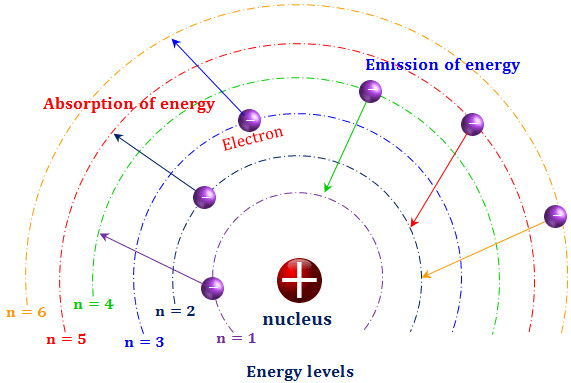
Bohr-style picture of an atom with quantized energy levels
Inside the nucleus
- Protons
- Charge
- Determine the element
- Neutrons
- No charge
- Protons and neutrons have nearly equal mass.
- Each is about 1836 times more massive than an electron.
- Electron mass is so small that atomic mass is dominated by protons + neutrons.
Atomic number and isotopes
- Atomic number = number of protons
- Same → same element. Always.
- Mass number = protons + neutrons.
- Isotopes: same , different .
- Same chemistry (same electrons in neutral atoms).
- Different mass and sometimes different stability.
Nuclear notation looks like this:
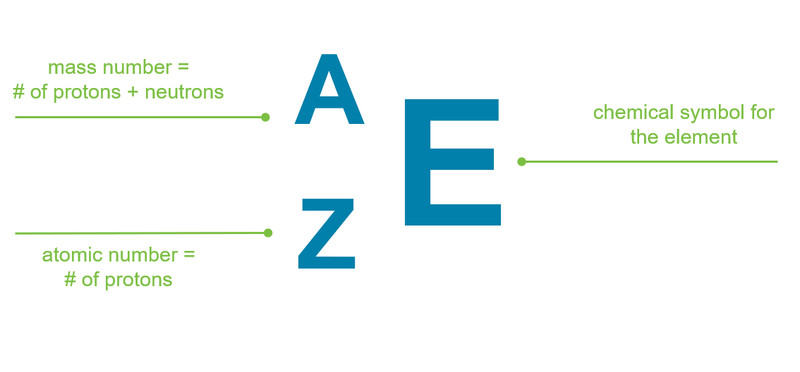
Standard nuclear notation
If you’re given and , you can always find:
- Protons =
- Neutrons =
Ions
A neutral atom has equal protons and electrons.
An ion has a net charge:
- Lose electrons → cation (positive)
- Gain electrons → anion (negative)
On tests, they love giving you p, n, and e⁻ and asking for the element and charge. Go straight to proton count first. That identifies the element every time.
Why electrons matter
The number and arrangement of electrons determine how atoms interact chemically. The outermost energy level (valence level) controls most chemical behavior.
2. The Bohr Model
In 1913, Bohr proposed a model for hydrogen that combined:
- Coulomb’s law
- Circular motion
- A new idea: energy is quantized
Important boundary: on AP Physics 2, you only deal with energy levels, not orbital shapes or probability clouds.
In the Bohr model:
- Electrons move in circular orbits.
- The attractive electric force between proton and electron keeps the electron in orbit.
- Only certain orbits are allowed.
3. Electric Force Provides Centripetal Force
An orbiting electron is in circular motion, so it needs centripetal force.
The electric force between proton and electron is:
Centripetal force requirement:
For a stable orbit, these must be equal:
This equation links:
- Orbital radius
- Electron speed
- Electric interaction
Conceptually, the electric force plays the role gravity plays for planets.
4. Quantized Energy Levels
The key result for hydrogen:
- is the ground state
- Higher → higher energy (less negative)
Important ideas:
- Energies are negative because the electron is bound.
- eV corresponds to ionization.
- Levels get closer together as increases.
This discrete pattern explains hydrogen’s line spectrum.
5. Standing Waves and Allowed Orbits
Bohr’s “allowed orbits” can be understood using de Broglie waves:
For a stable orbit:
The circumference must fit an integer number of wavelengths.
If it doesn’t, the wave destructively interferes and the orbit is not allowed. That’s why energy levels are discrete.
This idea often shows up conceptually. If the circumference doubles, more wavelengths can fit, meaning a higher .
6. Photon Emission and Absorption
When an electron changes levels:
- Moves up in energy → absorbs a photon.
- Moves down → emits a photon.
Example idea: if an electron drops from to , compute each energy using , subtract, and that difference equals .
On free-response, you must explain this in words:
“The electron transitions to a lower energy state, so the atom emits a photon whose energy equals the difference between the two energy levels.”
That sentence structure earns points.
